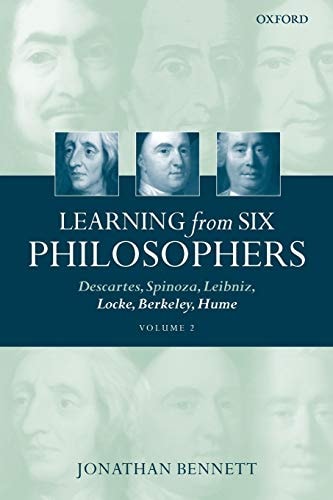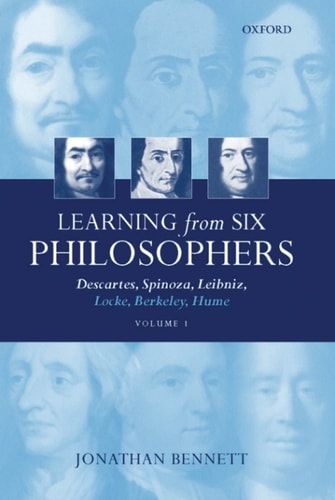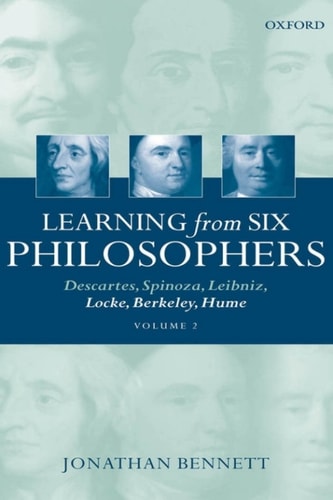
Learning from Six Philosophers: Descartes, Spinoza, Leibniz, Locke, Berkeley, Hume, Volume 2
0
0
As an Amazon Associate and affiliate partner, Menrva Books earns from qualifying purchases. Learn more
Author Description
Jonathan Bennett engages with the thought of six great thinkers of the early modern period: Descartes, Spinoza, Leibniz, Locke, Berkeley, Hume. While not neglecting the historical setting of each, his chief focus is on the words they wrote. What problem is being tackled? How exactly is the solution meant to work? Does it succeed? If not, why not? What can we learn from its success or its failure? These questions reflect Bennett's dedication to engaging with philosophy as philosophy, not as museum exhibit, and they require a close and demanding attention to textual details; these being two features that characterize all Bennett's work on early modern philosophy. For newcomers to the early modern scene, this clearly written work is an excellent introduction to it. Those already in the know can learn how to argue with the great philosophers of the past, treating them as colleagues, antagonists, students, teachers. Volume 2: In this volume Jonathan Bennett examines the views of Locke, Berkeley, and Hume on thought and sensation, meaning, language, classification, innate ideas and knowledge, our knowledge of necessary truths (bringing in Descartes and Leibniz as well), the basis for our belief that we live in a world of material things, causation, the fundamental difference between colours and shapes, the passage of time and our ability to live through it. While finding much to criticize, Bennett shows that we can learn much about these and other topics under the guidance and inspiration of the energy, courage, and insight of these three great British philosophers.
Menrva's Summary
THE THESIS
This work investigates how the foundational arguments of Locke, Berkeley, and Hume regarding thought, sensation, and knowledge remain relevant to contemporary philosophical inquiry. Jonathan Bennett, a prominent scholar of early modern philosophy, utilizes a rigorous analytical approach to dissect the primary texts of these thinkers. By treating these historical figures as active participants in ongoing philosophical debates rather than static museum exhibits, Bennett evaluates the success and failure of their specific arguments. The text serves as both an introduction for newcomers and a methodological guide for experienced students on how to engage critically with historical philosophical positions.
THE SCOPE MAP
What You Will Find
- Analysis of Locke, Berkeley, and Hume on innate ideas, meaning, and language.
- Examination of the philosophical basis for belief in a material world.
- Discussion on causation, the nature of time, and the distinction between primary and secondary qualities.
- Comparative insights involving Descartes and Leibniz.
Scope Limits
- The volume does not provide a comprehensive biography of the philosophers, focusing instead on their written arguments.
- It does not cover the entirety of the early modern period, limiting its scope to the specific British empiricist tradition and selected rationalist counterpoints.
THE AUTHORITY PERSPECTIVE
Scholars and students frequently highlight Bennett's ability to render complex early modern arguments accessible without sacrificing analytical rigor. Experts often cite this text as a foundational resource for learning how to perform close textual analysis and engage in constructive debate with historical philosophical works.
Page Count:
400
Publication Date:
2001-01-01
Publisher:
Clarendon Press
ISBN-10:
0191520306
ISBN-13:
9780191520303
Philosophy
Metaphysics
Philosophy history
History & Surveys
Early Modern
Epistemology