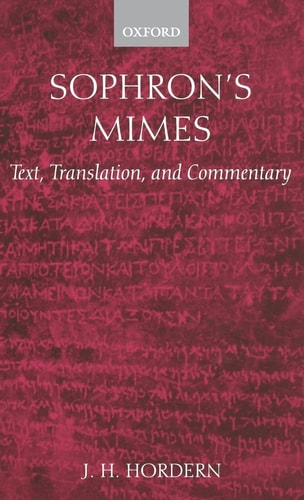
Sophron's Mimes: Text, Translation, and Commentary
0
0
As an Amazon Associate and affiliate partner, Menrva Books earns from qualifying purchases. Learn more
Author Description
Sophron of Syracuse, who lived in Sicily in the late fifth/early fourth century BC, represents our only surviving example of classical Greek mime. The mimes (short playlets) are also an important example of the classical literary tradition outside Athens. The Greek text is based on the standard modern edition, but with significant additions, and a translation is provided. There is a detailed commentary that deals with linguistic questions, as well as discussing Sophron's relationship with earlier traditions (for example, iambus) and later literature (such as his influence on the work of Theocritus). A substantial introduction discusses important issues such as performance and audience.
Menrva's Summary
THE THESIS
This volume investigates the surviving fragments of Sophron of Syracuse to define his unique contribution to the classical Greek mime tradition. J. H. Hordern, a scholar of Hellenistic literature, provides a comprehensive analysis of these short playlets, which represent a rare non-Athenian perspective on classical drama. By synthesizing linguistic analysis with historical context, the author argues for the significance of Sophron’s work as a bridge between early iambic traditions and the later pastoral poetry of Theocritus.
THE SCOPE MAP
What You Will Find
- A critical edition of the Greek text of Sophron’s mimes with updated commentary.
- A complete English translation of the surviving fragments.
- An examination of the performance context and audience dynamics in fifth-century BC Sicily.
- A comparative study of Sophron’s influence on subsequent literary figures.
THE AUTHORITY PERSPECTIVE
Scholars and students of classical philology regard this work as a foundational resource for understanding the development of the mime genre. Readers frequently note the academic density of the prose and the precision of the linguistic commentary provided by Hordern.
Page Count:
218
Publication Date:
2004-08-05
Publisher:
Oxford University Press
ISBN-10:
0199266131
ISBN-13:
9780199266135
Drama
History
Literary Criticism
Criticism history
Ancient Greek
Community Tags
Similar Books