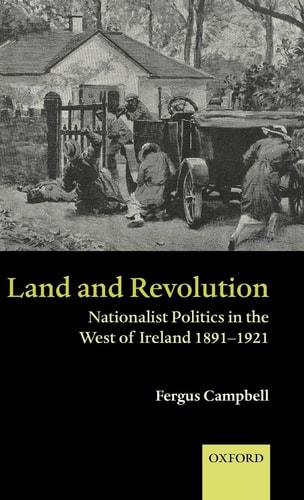
Land and Revolution: Nationalist Politics in the West of Ireland 1891-1921
0
0
As an Amazon Associate and affiliate partner, Menrva Books earns from qualifying purchases. Learn more
Author Description
In the 1890s, most of the inhabitants of the west of Ireland experienced great poverty and hardship, living - as they did - on farms that were too small to provide them with a reasonable standard of living. By 1921, however, the living conditions of many of them had been transformed by a series of Land Acts that revolutionized the system of land holding in Ireland. This book examines agrarian conflict in Ireland during the neglected period between the death of Parnell (1891) and the signing of the Anglo-Irish Treaty (1921), and demonstrates that land reform was often introduced in response to popular protest.Whereas earlier accounts have tended to examine Irish political history from the perspective of British governments or nationalist leaders, this book breaks new ground by providing an account of popular political activity in late nineteenth- and twentieth-century Ireland. For the first time, the social background, ideas, and activities of grass-roots political activists are systematically explored, as are the class conflicts that threatened to fragment the unity of the nationalist movement in rural communities. By reinserting the activism of ordinary people into the broader historical record, Dr Campbell suggests new interpretations of a number of critical developments including the failure of 'constructive unionism', the origins of Sinn Féin, and the nature and dynamics of the Irish revolution (1916-23). Using the recently released archives of the Bureau of Military History, the story of the war of independence in the western county of Galway is told in the words of both the Irish Republican Army and its enemies.Land and Revolution transforms our understanding of late nineteenth- and early twentieth-century Irish history, and also contributes to comparative studies of nationalism, revolution, and agrarian protest.
Menrva's Summary
THE THESIS
This book investigates the relationship between agrarian protest and the evolution of nationalist politics in the west of Ireland between 1891 and 1921. Dr. Fergus Campbell, a historian specializing in Irish social and political history, utilizes archival records to argue that land reform was not merely a top-down legislative process but a direct response to grassroots activism. By shifting the focus from elite political leaders to the rural populace, the work provides a framework for understanding how class conflict and land ownership shaped the trajectory of the Irish revolution.
THE SCOPE MAP
What You Will Find
- Analysis of the impact of Land Acts on rural living conditions in the west of Ireland.
- Examination of the social background and political motivations of grassroots activists.
- Use of primary source material from the Bureau of Military History archives.
- Comparative study of the dynamics of nationalism, revolution, and agrarian protest.
THE AUTHORITY PERSPECTIVE
Historians and scholars of Irish studies frequently cite this work for its detailed analysis of regional political activity and its departure from traditional top-down historical narratives. The text is recognized for its academic rigor and its contribution to understanding the complexities of the Irish revolutionary period.
Page Count:
376
Publication Date:
2005-04-21
Publisher:
Oxford University Press
ISBN-10:
0199273243
ISBN-13:
9780199273249
History
Nationalism
Social History
Irish History
Community Tags
Similar Books