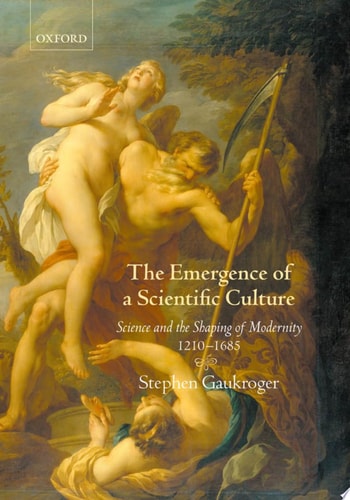
The Emergence of a Scientific Culture: Science and the Shaping of Modernity 1210-1685
0
0
As an Amazon Associate and affiliate partner, Menrva Books earns from qualifying purchases. Learn more
Author Description
Why did science emerge in the West and how did scientific values come to be regarded as the yardstick for all other forms of knowledge? Stephen Gaukroger shows just how bitterly the cognitive and cultural standing of science was contested in its early development. Rejecting the traditional picture of secularization, he argues that science in the seventeenth century emerged not in opposition to religion but rather was in many respects driven by it. Moreover, science did not present a unified picture of nature but was an unstable field of different, often locally successful but just as often incompatible, programmes. To complicate matters, much depended on attempts to reshape the persona of the natural philosopher, and distinctive new notions of objectivity and impartiality were imported into natural philosophy, changing its character radically by redefining the qualities of its practitioners.The West's sense of itself, its relation to its past, and its sense of its future, have been profoundly altered since the seventeenth century, as cognitive values generally have gradually come to be shaped around scientific ones. Science has not merely brought a new set of such values to the task of understanding the world and our place in it, but rather has completely transformed the task, redefining the goals of enquiry. This distinctive feature of the development of a scientific culture in the West marks it out from other scientifically productive cultures. In The Emergence of a Scientific Culture, Stephen Gaukroger offers a detailed and comprehensive account of the formative stages of this development--and one which challenges the received wisdom that science was seen to be self-evidently the correct path to knowledge and that the benefits of science were immediately obvious to the disinterested observer.
Menrva's Summary
THE THESIS
This book investigates the historical processes by which science transitioned from a contested field of inquiry to the primary arbiter of knowledge in Western culture between 1210 and 1685. Stephen Gaukroger, a professor of history and philosophy of science, utilizes a vast array of primary source material to challenge the narrative of secularization. He argues that the emergence of scientific culture was deeply intertwined with religious motivations and that the transformation of the natural philosopher's persona was essential to establishing modern scientific objectivity.
THE SCOPE MAP
What You Will Find
- A detailed examination of the intellectual shift from medieval natural philosophy to early modern science.
- Analysis of the changing social and cognitive requirements for the persona of the natural philosopher.
- Historical evidence demonstrating the complex, often non-secular origins of scientific inquiry.
- Exploration of how scientific values became the dominant framework for understanding human knowledge and societal goals.
THE AUTHORITY PERSPECTIVE
Scholars frequently cite this work as a rigorous, dense examination of the intellectual foundations of Western science. It is widely regarded as a foundational text for those studying the history of ideas and the cultural evolution of scientific methodology.
Page Count:
572
Publication Date:
2007-02-08
Publisher:
Clarendon Press
ISBN-10:
0199296448
ISBN-13:
9780199296446
Science
History
Philosophy
Sociology of Science
Science europe
Intellectual History
Community Tags
Similar Books