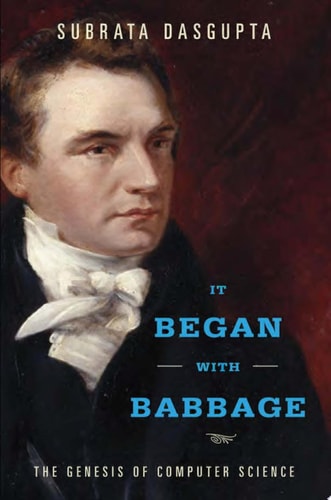
It Began with Babbage: The Genesis of Computer Science
0
0
As an Amazon Associate and affiliate partner, Menrva Books earns from qualifying purchases. Learn more
Author Description
As a field, computer science occupies a unique scientific space, in that its subject matter can exist in both physical and abstract realms. An artifact such as software is both tangible and not, and must be classified as something in between, or "liminal." The study and production of liminal artifacts allows for creative possibilities that are, and have been, possible only in computer science. In It Began with Babbage, computer scientist and writer Subrata Dasgupta examines the distinct history of computer science in terms of its creative innovations, reaching back to Charles Babbage in 1819. Since all artifacts of computer science are conceived with a use in mind, the computer scientist is not concerned with the natural laws that govern disciplines like physics or chemistry; instead, the field is more concerned with the concept of purpose. This requirement lends itself to a type of creative thinking that, as Dasgupta shows us, has exhibited itself throughout the history of computer science. More than any other, computer science is the science of the artificial, and has a unique history to accompany its unique focus.The book traces a path from Babbage's Difference Engine in the early 19th century to the end of the 1960s by when a new academic discipline named "computer science" had come into being. Along the way we meet characters like Babbage and Ada Lovelace, Turing and von Neumann, Shannon and Chomsky, and a host of other people from a variety of backgrounds who collectively created this new science of the artificial. And in the end, we see how and why computer science acquired a nature and history all of its own.
Menrva's Summary
THE THESIS
How does the unique nature of computer science as a 'science of the artificial' define its historical development and creative innovation? Subrata Dasgupta, an established computer scientist and author, investigates the evolution of the field by focusing on the concept of 'liminal' artifacts—objects that exist simultaneously in physical and abstract realms. He argues that because computer science is driven by purpose rather than natural laws, its history is defined by a distinct form of creative thinking that separates it from traditional scientific disciplines.
THE SCOPE MAP
What You Will Find
- A historical timeline spanning from Charles Babbage's 19th-century Difference Engine to the formal establishment of computer science in the late 1960s.
- An analysis of the 'science of the artificial' framework and how it governs technological innovation.
- Biographical sketches of foundational figures including Ada Lovelace, Alan Turing, John von Neumann, Claude Shannon, and Noam Chomsky.
- A conceptual exploration of software and hardware as liminal artifacts that bridge the gap between abstract logic and physical utility.
THE AUTHORITY PERSPECTIVE
Experts and readers recognize this work as a thoughtful synthesis of technical history and philosophical inquiry into the nature of computing. The text is frequently cited for its ability to contextualize the contributions of key pioneers within the broader evolution of the discipline.
Page Count:
344
Publication Date:
2014-01-01
Publisher:
Oxford University Press
ISBN-10:
0199309434
ISBN-13:
9780199309436
Non-Fiction
Biography
Professional Career & Trade
Technology
Computer Science
Community Tags
Similar Books