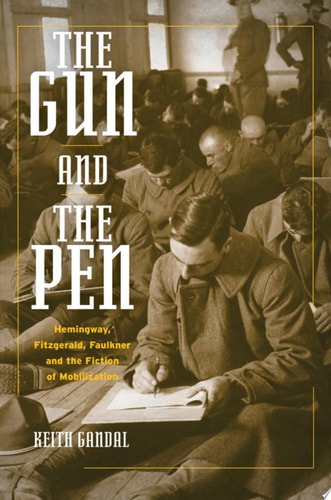
The Gun and the Pen: Hemingway, Fitzgerald, Faulkner, and the Fiction of Mobilization
0
0
As an Amazon Associate and affiliate partner, Menrva Books earns from qualifying purchases. Learn more
Author Description
Ernest Hemingway, F. Scott Fitzgerald, and William Faulkner stand as the American voice of the Great War. But was it warfare that drove them to write? Not according to Keith Gandal, who argues that the authors' famous postwar novels were motivated not by their experiences of the horrors of war but rather by their failure to have those experiences. These 'quintessential' male American novelists of the 1920s were all, for different reasons, deemed unsuitable as candidates for full military service or command. As a result, Gandal contends, they felt themselves emasculated--not, as the usual story goes, due to their encounters with trench warfare, but because they got nowhere near the real action. Bringing to light previously unexamined Army records, including new information about the intelligence tests, The Gun and the Pen demonstrates that the authors' frustrated military ambitions took place in the forgotten context of the unprecedented U.S. mobilization for the Great War, a radical effort to transform the Army into a meritocratic institution, indifferent to ethnic and class difference (though not to racial difference). For these Lost Generation writers, the humiliating failure vis-à-vis the Army meant an embarrassment before women and an inability to compete successfully in a rising social order, against a new set of people. The Gun and the Pen restores these seminal novels to their proper historical context and offers a major revision of our understanding of America's postwar literature.
Menrva's Summary
THE THESIS
Does the perceived trauma of World War I combat truly explain the literary output of the Lost Generation, or did the authors' failure to serve in the military drive their creative motivations? Keith Gandal, a scholar of American literature, challenges the long-standing critical consensus that trench warfare defined the postwar novels of Hemingway, Fitzgerald, and Faulkner. By analyzing previously unexamined Army records and the socio-political context of U.S. mobilization, Gandal argues that these writers were motivated by the emasculation resulting from their exclusion from combat, rather than the psychological scars of the battlefield itself.
THE SCOPE MAP
What You Will Find
- Analysis of U.S. Army mobilization records and intelligence testing protocols from the Great War era.
- A re-evaluation of the biographical histories of Ernest Hemingway, F. Scott Fitzgerald, and William Faulkner regarding their military service status.
- Examination of the intersection between meritocratic military reform and social class dynamics in early 20th-century America.
- A critical framework linking personal military failure to the thematic concerns of masculinity and social competition in 1920s literature.
THE AUTHORITY PERSPECTIVE
Scholars and literary critics frequently note the academic density of the prose and the rigor of Gandal's archival research. Experts highlight this work as a significant revisionist text that forces a re-examination of the foundational myths surrounding the Lost Generation.
Page Count:
284
Publication Date:
2010-01-01
Publisher:
Oxford University Press
ISBN-10:
0199313989
ISBN-13:
9780199313983
Biography
History
American
Military History
English & College Success
Literary Criticism
United States
English
Community Tags
Similar Books