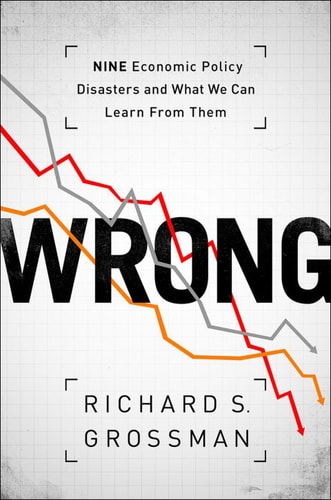
Wrong: Nine Economic Policy Disasters and What We Can Learn from Them
0
0
As an Amazon Associate and affiliate partner, Menrva Books earns from qualifying purchases. Learn more
Author Description
In recent years, the world has been rocked by major economic crises, most notably the devastating collapse of Lehman Brothers, the largest bankruptcy in American history, which triggered the breathtakingly destructive sub-prime disaster. What sparks these vast economic calamities? Why do our economic policy makers fail to protect us from such upheavals? In Wrong, economist Richard Grossman addresses such questions, shining a light on the poor thinking behind nine of the worst economic policy mistakes of the past 200 years, missteps whose outcomes ranged from appalling to tragic. Grossman tells the story behind each misconceived economic move, explaining why the policy was adopted, how it was implemented, and its short- and long-term consequences. In each case, he shows that the main culprits were policy makers who were guided by ideology rather than economics. For instance, Wrong looks at how America's unfounded fear of a centralized monetary authority caused them to reject two central banks, condemning the nation to wave after wave of financial panics. He describes how Britain's blind commitment to free markets, rather than to assisting the starving in Ireland, led to one of the nineteenth century's worst humanitarian tragedies- the Irish famine. And he shows how Britain's reestablishment of the gold standard after World War I, fuelled largely by a desire to recapture its pre-war dominance, helped to turn what would otherwise have been a normal recession into the Great Depression. Grossman also explores the Smoot-Hawley Tariff of 1930, Japan's lost decade of the 1990s, the American subprime crisis, and the present European sovereign debt crisis.Economic policy should be based on cold, hard economic analysis, Grossman concludes, not on an unquestioning commitment to a particular ideology. Wrong shows what happens when this sensible advice is ignored.
Menrva's Summary
THE THESIS
What systemic failures and ideological biases drive the most catastrophic economic policy decisions in modern history? Economist Richard S. Grossman investigates nine significant economic blunders spanning the last two centuries to determine why policymakers repeatedly ignore empirical analysis in favor of rigid ideological frameworks. By examining the implementation and aftermath of these specific missteps, the author argues that the recurring failure to protect global markets stems from a preference for political dogma over sound economic reasoning.
THE SCOPE MAP
What You Will Find
- Analysis of nine major economic policy failures including the Irish Famine, the Great Depression, and the 2008 subprime mortgage crisis.
- Examination of the role of ideological bias in shaping central banking, trade tariffs, and gold standard policies.
- Historical case studies detailing the implementation and long-term consequences of flawed government interventions.
- A comparative framework for evaluating how policy decisions deviate from standard economic theory.
THE AUTHORITY PERSPECTIVE
Experts and readers alike note that Grossman provides a clear, accessible analysis of complex historical economic events without relying on overly dense jargon. The text is frequently cited as a useful resource for understanding the intersection of political ideology and financial instability.
Page Count:
285
Publication Date:
2013-01-01
Publisher:
Oxford University Press
ISBN-10:
019932221X
ISBN-13:
9780199322213
Non-Fiction
History
Economics
Finance
Economics history
Community Tags
Other Editions(2)

Similar Books

Reader Comments
Share Your Thoughts
No comments yet. Be the first to share your thoughts!