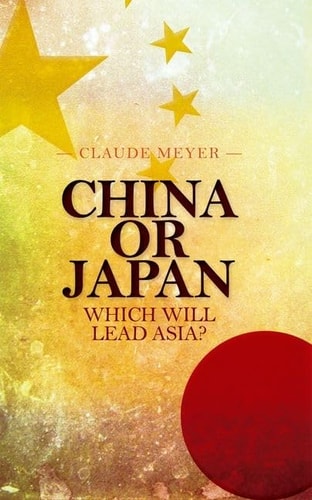
China or Japan: Which Will Lead Asia?
0
0
As an Amazon Associate and affiliate partner, Menrva Books earns from qualifying purchases. Learn more
Author Description
The twenty-first century will doubtless be that of Asia, which by 2030 will be home to three of the world's four mightiest economies, including India. This stimulating book aims to open a debate on the question of leadership in Asia for which China and Japan are competing. It assesses the two rivals' strengths and weaknesses as well as the major challenges which they will face in that battle for supremacy. On this basis, it proposes the most probable scenario for the next two decades in the light of the dialectical relationship between economics and strategic power. Without neglecting the strategic aspects that give advantage to China, priority is given to an economic approach, because that is the primary arena in which Asian integration is taking place and the one in which a resilient Japan still firmly maintains its leadership, based on productivity, competitiveness and technological edge.
Menrva's Summary
THE THESIS
This book investigates the shifting geopolitical and economic landscape of Asia to determine whether China or Japan is better positioned to secure regional leadership in the twenty-first century. Claude Meyer, an expert in international studies, utilizes a comparative framework to analyze the economic productivity, technological capabilities, and strategic power of both nations. By examining the dialectical relationship between economic growth and strategic influence, the author provides a projected scenario for the next two decades of Asian development.
THE SCOPE MAP
What You Will Find
- Comparative analysis of Chinese and Japanese economic strengths and weaknesses
- Evaluation of technological competitiveness and industrial productivity
- Assessment of regional integration strategies within the Asian market
- Strategic projections for the next twenty years of geopolitical influence
THE AUTHORITY PERSPECTIVE
Experts note that the text provides a balanced economic perspective on a traditionally security-focused debate. Readers frequently highlight the author's focus on productivity and competitiveness as a useful lens for understanding the ongoing rivalry between these two Asian powers.
Page Count:
208
Publication Date:
2012-01-31
Publisher:
Oxford University Press
ISBN-10:
0199327610
ISBN-13:
9780199327614
Politics
History
Economics
International relations
Asian Studies
New Used & Rental Textbooks
Central Asia
Asia
Geopolitics
World politics
Community Tags
Other Editions(2)
Similar Books