Law's Cut on the Body of Human Rights: Female Circumcision, Torture and Sacred Flesh
0
0
As an Amazon Associate and affiliate partner, Menrva Books earns from qualifying purchases. Learn more
Author Description
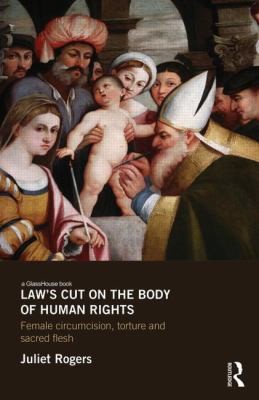
Scenes of violence and incisions into the flesh inform the demand for law. The scene of little girls being held down in practices of female circumcision has been a defining and definitive image that demands the attention of human rights, and the intervention of law. But the investment in protecting women and little girls from such a cut is not all that it seems. Law's Cut on the Body of Human Rights: Female Circumcision, Torture and Sacred Flesh considers how such images come to inform law and the investment of advocates of law in the imagination of this scene. Drawing on psychoanalytic and postcolonial theory, and accompanying ideas in political theology, Juliet Rogers examines the language, imagery and excitement that accompanies recent initiatives to legislate against what is called 'female genital mutilation'. The author complements this examination with a consideration of the scene of torture exposed in images from Abu Ghraib and Guantanamo Bay. Rogers argues that the modes of fascination and excitement that accompany scenes of torture and female circumcision betray the fantasy of a political condition against which the subject of liberal law is imagined; this is a subjectivity in a state of non-mutilation, non-prohibition or, in a psychoanalytic idiom, non-castration. To support the fantasy of this subject, the mutilated subject, the author suggests, is rendered as flesh cut from the democratic nation state, deserving of only selective human rights, or none at all
Menrva's Summary
THE THESIS
This book investigates the complex relationship between the demand for law and the imagery of violence, particularly concerning female circumcision and its representation within human rights discourse. Juliet Rogers, drawing on psychoanalytic and postcolonial theory, examines how images of female circumcision and torture, such as those from Abu Ghraib and Guantanamo Bay, shape legal interventions and advocacy. The author argues that the fascination with these scenes reveals a fantasy of a political subject free from mutilation or prohibition, a subjectivity essential to liberal law. This analysis suggests that the 'mutilated subject' is often rendered as separate from the democratic state, thereby justifying selective or absent human rights.
THE SCOPE MAP
- Analysis of the imagery and language surrounding initiatives to legislate against female genital mutilation.
- Exploration of psychoanalytic and postcolonial theoretical frameworks applied to human rights law.
- Consideration of the scene of torture as depicted in images from Abu Ghraib and Guantanamo Bay.
- Examination of the 'political condition' and the fantasy of a liberal legal subject.
- Discussion of the 'mutilated subject' and their position within the democratic nation-state.
- Critique of selective human rights application based on perceived 'mutilation'.
THE AUTHORITY PERSPECTIVE
The book is positioned as a critical examination of how legal and human rights frameworks engage with sensitive cultural practices like female circumcision. It is likely to be regarded as a dense, theoretically-driven text that challenges conventional understandings of victimhood and legal intervention. The author's use of psychoanalytic and postcolonial lenses suggests an approach that prioritizes deconstruction of underlying assumptions within human rights discourse. The work appears to be aimed at an academic audience interested in the intersection of law, politics, and cultural critique.
Page Count:
169
Publication Date:
2012-01-01
ISBN-10:
0415661706
ISBN-13:
9780415661706
Politics
Non-Fiction
Philosophy
Law
Psychoanalytic Theory
Postcolonial Theory
Feminist Theory
Human rights
Sociology
Community Tags
Similar Books