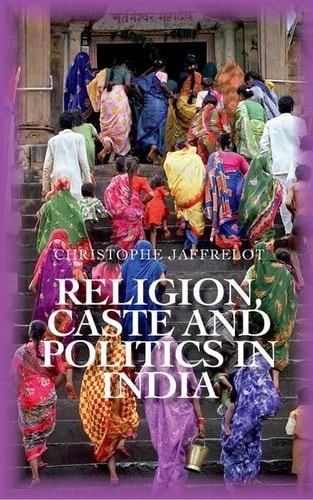
Religion, Caste and Politics in India: Comparative Politics and International Studies
0
0
As an Amazon Associate and affiliate partner, Menrva Books earns from qualifying purchases. Learn more
Author Description
After Independence the Nehruvian approach to socialism in India rested upon three pillars: secularism and democracy in the political domain; state intervention in the economy; and diplomatic Non-Alignment mitigated by pro-Soviet leanings after the 1960s. These features defined the "Indian model," and even the country's political identity. From this starting point Christophe Jaffrelot explores the manner in which some of these dimensions have been transformed over the course of time, more especially since the 1980-90s. The world's largest democracy has sustained itself by making more room, not only for the vernacular politicians of the linguistic states, but also for Dalits and OBCs, at least after the Mandal Commission report. But the simultaneous--and related--rise of Hindu nationalism has put the minorities--and secularism--on the defensive, and in many ways the rule of law is on trial too. The liberalisaton of the economy has resulted in growth but not necessarily in development: while the new middle class is changing the face of urban India, the rural areas lag behind and inequalities have become more acute. India has also acquired a new global status, that of an emerging power seeking new political and economic partnerships in Asia and in the West, where the United States remains the first choice of the Indian middle class. The traditional Nehruvian system is giving way to a less cohesive but a more active India, a country that has already become what it is against all the odds. Christophe Jaffrelot tracks India's tumultuous journey of recent decades, exploring the role of religion, caste and politics in weaving the fabric of a modern democratic state.
Menrva's Summary
THE THESIS
This work investigates how the traditional Nehruvian political model of India has been fundamentally transformed by the rise of Hindu nationalism, caste-based political mobilization, and economic liberalization since the 1980s. Christophe Jaffrelot, a prominent political scientist specializing in South Asian affairs, utilizes historical analysis and sociopolitical data to examine the shifting identity of the world's largest democracy. He argues that while India has achieved status as an emerging global power, the internal cohesion of its secular and democratic foundations faces significant challenges from rising inequality and religious polarization.
THE SCOPE MAP
What You Will Find
- Analysis of the transition from Nehruvian socialism to contemporary market-oriented policies.
- Examination of the political impact of the Mandal Commission report on Dalit and OBC representation.
- Assessment of the rise of Hindu nationalism and its effects on minority rights and secular governance.
- Evaluation of India's evolving foreign policy and its strategic partnerships in Asia and the West.
THE AUTHORITY PERSPECTIVE
Experts recognize this text as a comprehensive analysis of modern Indian political development, frequently citing Jaffrelot's ability to synthesize complex social and economic shifts. Readers often note the academic density of the prose, which provides a rigorous framework for understanding the structural changes within the Indian state.
Page Count:
600
Publication Date:
2011-08-16
Publisher:
Oxford University Press
ISBN-10:
0199327521
ISBN-13:
9780199327522
Religion
History
Politics
Sociology
India
New Used & Rental Textbooks
Class
Church & State
Caste
Specific Topics
World politics
Asia
Community Tags
Similar Books