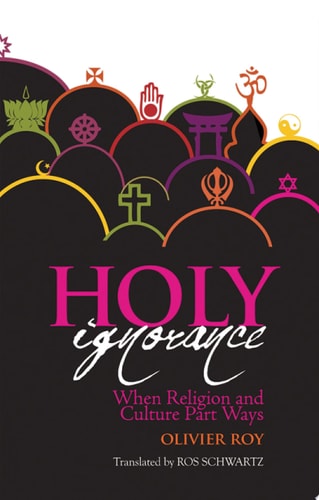
Holy Ignorance: When Religion and Culture Part Ways
0
0
As an Amazon Associate and affiliate partner, Menrva Books earns from qualifying purchases. Learn more
Author Description
Olivier Roy, world-renowned authority on Islam and politics, finds in the modern disconnection between faith communities and socio-cultural identities a fertile space for fundamentalism to grow. Instead of freeing the world from religion, secularization has encouraged a kind of holy ignorance to take root, an anti-intellectualism that promises immediate, emotional access to the sacred and positions itself in direct opposition to contemporary pagan culture. The secularization of society was supposed to free people from religion, yet individuals are converting en masse to fundamentalist faiths, such as Protestant evangelicalism, Islamic Salafism, and Haredi Judaism. These religions either reconnect adherents to their culture through casual referents, like halal fast food, or maintain their momentum through purification rituals, such as speaking in tongues, a practice that allows believers to utter a language that is entirely their own. Instead of a return to traditional religious worship, we are now witnessing the individualisation of faith and the disassociation of faith communities from ethnic and national identities. Roy explores the options now available to powers that hope to integrate or control these groups; and whether marginalisation or homogenisation will further divide believers from their culture.
Menrva's Summary
THE THESIS
Olivier Roy investigates the paradox of why secularization has not led to the decline of religion, but rather to the rise of fundamentalist movements that are increasingly disconnected from traditional cultural identities. Roy, a prominent scholar of Islam and political science, utilizes a comparative analysis of global religious trends to argue that the modern individualization of faith creates a vacuum filled by anti-intellectual, fundamentalist expressions of belief. He examines how this phenomenon manifests across diverse traditions, including Protestant evangelicalism, Salafism, and Haredi Judaism, to demonstrate that religion is being reshaped into a de-territorialized, personal experience.
THE SCOPE MAP
What You Will Find
- Comparative analysis of Protestant evangelicalism, Islamic Salafism, and Haredi Judaism
- Examination of the disconnect between religious practice and ethnic or national identity
- Discussion on the role of secularization in fostering fundamentalist growth
- Exploration of state strategies for integrating or managing religious minority groups
THE AUTHORITY PERSPECTIVE
Experts recognize this work as a significant contribution to the sociology of religion, noting its ability to synthesize complex geopolitical trends into a coherent argument. Readers frequently highlight the author's clinical approach to sensitive topics, making it a foundational text for those studying the intersection of faith and modern culture.
Page Count:
288
Publication Date:
2014-01-16
Publisher:
Oxford University Press
ISBN-10:
0199328021
ISBN-13:
9780199328024
Religion
Politics
Secularism
Sociology
Globalization
Community Tags
Other Editions(2)

Similar Books