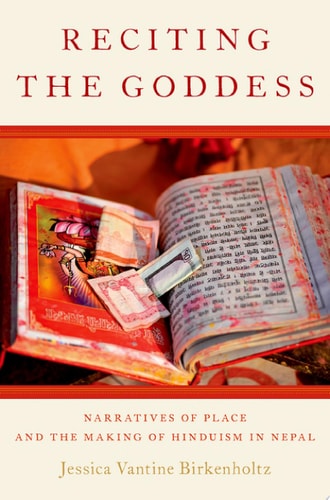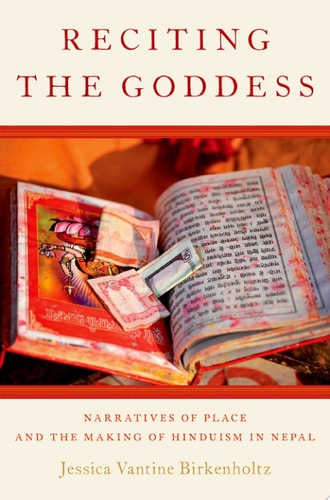
Reciting the Goddess
0
0
As an Amazon Associate and affiliate partner, Menrva Books earns from qualifying purchases. Learn more
Author Description
Reciting The Goddess presents the first critical study of the Svasthanivratakatha (SVK), a sixteenth-century Hindu narrative textual tradition. The extensive SVK manuscript tradition offers a rare opportunity to observe the making of a specific, distinct Hindu religious tradition. Jessica Vantine Birkenholtz argues that the SVK serves as a lens through which we can observe the creation of modern 'Hinduism' in the Himalayas, as the text both mirrored and informed key moments in the self-conscious creation of Nepal as the 'world's only Hindu kingdom' in the late medieval and early modern period. Birkenholtz mines the literary historiography that is contained within the SVK text itself, chronicling the text's literary and narrative development as well as the development of the Svasthani goddess tradition. She outlines the process whereby the SVK gradually transformed into a Purana text, and became a critical source for Nepali Hindu belief and identity. She also examines the elusive character of the Goddess Svasthani whose identity is tied to the pan-Hindu goddess tradition, and the representation of women in the SVK and the ways in which the text influenced local and regional debates on the ideal of Hindu womanhood. Reciting The Goddess presents Nepal's celebrated SVK as a micro-level illustration of the powerful ways in which people, place, and literature intersect to produce new ideas and concepts of identity and place, even in a historically non-literate culture.
Menrva's Summary
THE THESIS
This book investigates how the sixteenth-century Hindu narrative tradition, the Svasthanivratakatha (SVK), functioned as a foundational element in the construction of Nepali religious identity and the conceptualization of Nepal as a Hindu kingdom. Jessica Vantine Birkenholtz, a scholar of South Asian religions, utilizes an extensive collection of SVK manuscripts to trace the evolution of this text from its origins to its eventual status as a canonical Purana. By analyzing the intersection of literature, geography, and social practice, the author argues that the SVK provided a framework for local communities to define their religious identity and gender ideals during the late medieval and early modern periods.
THE SCOPE MAP
What You Will Find
- A detailed analysis of the Svasthanivratakatha (SVK) manuscript tradition and its literary historiography.
- An examination of the transformation of local narratives into the broader Purana genre.
- A study of the goddess Svasthani and her role in shaping regional debates on Hindu womanhood.
- A historical exploration of how religious texts informed the political and cultural identity of Nepal as a Hindu kingdom.
THE AUTHORITY PERSPECTIVE
Scholars in the field of South Asian studies recognize this work as a significant contribution to the understanding of regional religious traditions and manuscript history. Readers frequently note the academic density of the prose, which provides a rigorous examination of the interplay between textual development and cultural identity formation.
Page Count:
192
Publication Date:
2018-01-01
Publisher:
Oxford University Press
ISBN-10:
0199341184
ISBN-13:
9780199341184
Religion
History
Literary Criticism
Hinduism
Nepal
Community Tags
Similar Books