Unfinished Business: Michael Jackson, Detroit, and the Figural Economy of American Deindustrialization
0
0
As an Amazon Associate and affiliate partner, Menrva Books earns from qualifying purchases. Learn more
Author Description
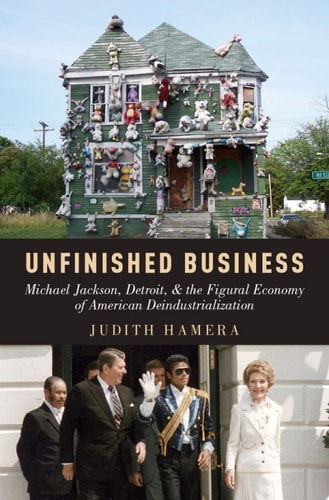
How does structural economic change look and feel? How are such changes normalized? Who represents hope? Who are the cautionary tales? Unfinished Business argues that U.S. deindustrialization cannot be understood apart from issues of race, and specifically apart from images of, and works by and about African Americans that represent or resist normative or aberrant relationships to work and capital in transitional times. It insists that Michael Jackson's performances and coverage of his life, plays featuring Detroit, plans for the city's postindustrial revitalization, and Detroit installations The Heidelberg Project and Mobile Homestead have something valuable to teach us about three decades of structural economic transition in the U.S., particularly about the changing nature of work and capitalism between the mid 1980s and 2016. Jackson and Detroit offer examples of the racialization of deindustrialization, how it operates as a structure of feeling and as representations as well as a shift in the dominant mode of production, and how industrialization's successor mode, financialization, uses imagery both very similar to and very different from its predecessor.
Menrva's Summary
THE THESIS
This book investigates how the structural economic shifts of American deindustrialization are mediated through racialized imagery and cultural representation. Judith Hamera, a scholar of performance and urban studies, utilizes a framework that connects the career of Michael Jackson and the urban evolution of Detroit to the broader transition from industrial capitalism to financialization. By analyzing these specific cultural touchstones, the author argues that economic decline is not merely a fiscal phenomenon but a lived experience shaped by racial narratives and public performance.
THE SCOPE MAP
What You Will Find
- Analysis of the intersection between racial identity and the economic decline of the American Rust Belt.
- Examination of Michael Jackson’s public persona as a reflection of shifting labor and capital dynamics.
- Case studies of Detroit-based art installations, including The Heidelberg Project and Mobile Homestead.
- A critical framework for understanding the transition from industrial production to contemporary financialization.
THE AUTHORITY PERSPECTIVE
Scholars in cultural studies and urban sociology identify this work as a significant contribution to the study of how economic structures are internalized and performed. Readers frequently note the academic density of the prose and the author's ability to synthesize disparate cultural artifacts into a cohesive economic critique.
Page Count:
304
Publication Date:
2017-11-16
Publisher:
Oxford University Press
ISBN-10:
0199348596
ISBN-13:
9780199348596
Economics
Social Aspects
Urban Studies
Sociology
American History
Community Tags
Other Editions(3)
Similar Books