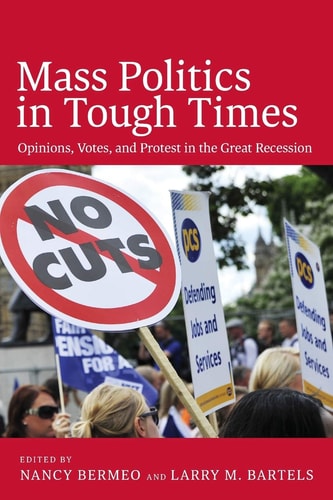
Mass Politics in Tough Times: Opinions, Votes, and Protest in the Great Recession
0
0
As an Amazon Associate and affiliate partner, Menrva Books earns from qualifying purchases. Learn more
Author Description
The impact of the Great Depression on politics in the 1930s was both transformative and shocking. The role of government in America was forever transformed, and across Europe socialist, communist, and fascist parties saw their support skyrocket. Most famously, the National Socialists seized power in Germany in 1933, setting off a chain of events that led to the greatest conflagration in world history. The recent Great Recession has not been as severe as the Great Recession, but it has been severe enough, producing a half decade of negative and/or slow growth across the advanced industrial world. Yet the response by voters has been extraordinarily muted considering the circumstances. Why is this?In Mass Politics in Tough Times, the eminent political scientists Larry Bartels and Nancy Bermeo have gathered a group of leading scholars to analyze the political responses to the Great Recession in the US, Western Europe, and East-Central Europe. In contrast to works that focus on policy responses to the Recession, they examine how ordinary voters have responded. In almost every country, most voters have not shifted their allegiance to either far left or far right parties. Instead, they've continued to act as they have in more normal times: vote based on their own personal circumstances and punish the incumbents who were on watch when the bad turn occurred regardless of whether they were center-left or center-right. In some countries, electoral trends that existed before the Recession have continued. The US, for instance, saw no real increase in popular support for an expanded welfare state. In fact, the anti-regulatory right, which gained strength before the Recession occurred, experienced a series of victories in Wisconsin after 2008. Interestingly, states that had strong welfare systems have seen the least political realignment. As the contributors show, ordinary voters tend to vote based on their own experiences, and those in expansive welfare states have been buffered
Menrva's Summary
THE THESIS
This book investigates why the political response of voters to the Great Recession remained remarkably muted compared to the radical shifts observed during the Great Depression. Larry M. Bartels and Nancy Gina Bermeo, both distinguished scholars in political science, curate a collection of essays from leading experts to examine electoral behavior across the United States, Western Europe, and East-Central Europe. By analyzing voter data and political trends, the authors argue that ordinary citizens largely continued to vote based on personal economic circumstances and incumbent performance rather than pivoting toward extremist ideologies.
THE SCOPE MAP
What You Will Find
- Comparative analysis of voter behavior in the US, Western Europe, and East-Central Europe following the 2008 financial crisis.
- Examination of the relationship between existing welfare state structures and political stability during economic downturns.
- Empirical evidence regarding the lack of significant shifts toward far-left or far-right political parties.
- Evaluation of incumbent punishment patterns versus ideological realignment in advanced industrial democracies.
THE AUTHORITY PERSPECTIVE
Experts recognize this volume as a significant contribution to the study of political behavior and economic crisis management. Readers frequently note the academic density of the prose and the rigorous empirical approach used to challenge common assumptions about voter radicalization.
Page Count:
400
Publication Date:
2014-01-21
Publisher:
Oxford University Press
ISBN-10:
019935751X
ISBN-13:
9780199357512
History
Economics
United States
Public Policy
Sociology
Comparative Politics
Community Tags
Similar Books





Reader Comments
Share Your Thoughts
No comments yet. Be the first to share your thoughts!