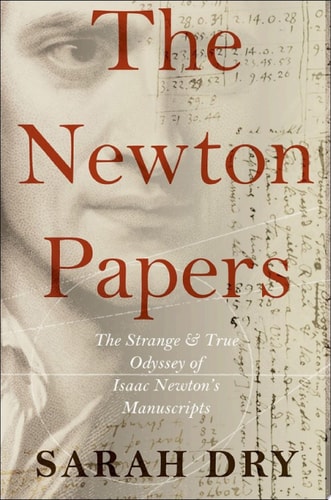
The Newton Papers: The Strange and True Odyssey of Isaac Newton's Manuscripts
0
0
As an Amazon Associate and affiliate partner, Menrva Books earns from qualifying purchases. Learn more
Author Description
When Isaac Newton died in 1727 without a will, he left behind a wealth of papers that, when examined, gave his followers and his family a deep sense of unease. Some of what they contained was wildly heretical and alchemically obsessed, hinting at a Newton altogether stranger and less palatable than the one enshrined in Westminster Abbey as the paragon of English rationality. These manuscripts had the potential to undermine not merely Newton's reputation, but that of the scientific method he embodied. They were immediately suppressed as "unfit to be printed," and, aside from brief, troubling glimpses spread across centuries, the papers would remain hidden from sight for more than seven generations.In The Newton Papers, Sarah Dry illuminates the tangled history of these private writings over the course of nearly three hundred years, from the long span of Newton's own life into the present day. The writings, on subjects ranging from secret alchemical formulas to impassioned rejections of the Holy Trinity, would eventually come to light as they moved through the hands of relatives, collectors, and scholars. The story of their disappearance, dispersal, and rediscovery is populated by a diverse cast of characters who pursued and possessed the papers, from economist John Maynard Keynes to controversial Jewish Biblical scholar Abraham Yahuda. Dry's captivating narrative moves between these varied personalities, depicting how, as they chased the image of Newton through the thickets of his various obsessions, these men became obsessed themselves with the allure of defining the "true" Newton. Dry skillfully accounts for the ways with which Newton's pursuers have approached his papers over centuries. Ultimately, The Newton Papers shows how Newton has been made and re-made throughout history by those seeking to reconcile the cosmic contradictions of an extraordinarily complex man.
Menrva's Summary
THE THESIS
This book investigates the complex, centuries-long struggle to control the legacy of Isaac Newton by examining the fate of his suppressed, private manuscripts. Sarah Dry, a historian of science, utilizes archival research and biographical analysis to trace how these controversial papers—containing alchemical and heretical writings—were hidden, dispersed, and eventually recovered. The work argues that Newton’s public image as a rationalist icon was a deliberate construction, maintained by those who feared his private obsessions would undermine the scientific method he represented.
THE SCOPE MAP
What You Will Find
- A detailed historical account of the dispersal of Newton's private papers from 1727 to the present day.
- Analysis of the motivations of various collectors, including John Maynard Keynes and Abraham Yahuda.
- Examination of the tension between Newton's scientific achievements and his private theological and alchemical pursuits.
- A study of how historical figures have curated and manipulated Newton's image to suit their own intellectual agendas.
THE AUTHORITY PERSPECTIVE
Experts and historians of science praise this work for its meticulous archival research and its nuanced exploration of the intersection between biography and historiography. Readers frequently note that the prose is accessible yet dense with historical detail, making it a significant contribution to the study of scientific legacy and intellectual history.
Page Count:
257
Publication Date:
2014-01-01
Publisher:
Oxford University Press
ISBN-10:
0199354197
ISBN-13:
9780199354191
Biography
Science
History
Non-Fiction
Earth Sciences
European History
Intellectual History
Science
Community Tags
Similar Books