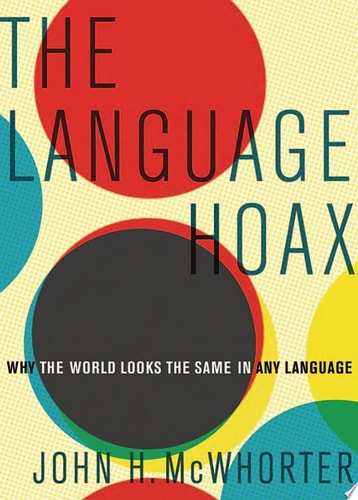
The Language Hoax
0
0
As an Amazon Associate and affiliate partner, Menrva Books earns from qualifying purchases. Learn more
Author Description
Japanese has a term that covers both green and blue. Russian has separate terms for dark and light blue. Does this mean that Russians perceive these colors differently from Japanese people? Does language control and limit the way we think?This short, opinionated book addresses the Sapir-Whorf hypothesis, which argues that the language we speak shapes the way we perceive the world. Linguist John McWhorter argues that while this idea is mesmerizing, it is plainly wrong. It is language that reflects culture and worldview, not the other way around. The fact that a language has only one word for eat, drink, and smoke doesn't mean its speakers don't process the difference between food and beverage, and those who use the same word for blue and green perceive those two colors just as vividly as others do.McWhorter shows not only how the idea of language as a lens fails but also why we want so badly to believe it: we're eager to celebrate diversity by acknowledging the intelligence of peoples who may not think like we do. Though well-intentioned, our belief in this idea poses an obstacle to a better understanding of human nature and even trivializes the people we seek to celebrate. The reality -- that all humans think alike -- provides another, better way for us to acknowledge the intelligence of all peoples.
Menrva's Summary
THE THESIS
Does the structure of a language dictate the cognitive limits of its speakers? John H. McWhorter, a linguist at Columbia University, investigates the Sapir-Whorf hypothesis, which posits that language shapes human perception. He argues that this theory is fundamentally flawed, asserting instead that language is a reflection of culture rather than a constraint on thought, and that human cognitive processes are universal across all linguistic groups.
THE SCOPE MAP
What You Will Find
- Analysis of the Sapir-Whorf hypothesis and its historical development.
- Comparative linguistic examples involving color perception and verb usage.
- Critique of the romanticized view of linguistic diversity.
- Argumentation regarding the universality of human cognition.
THE AUTHORITY PERSPECTIVE
Experts and readers frequently note the accessible, polemical style McWhorter employs to dismantle complex linguistic theories. The text is widely regarded as a foundational counter-argument to linguistic determinism for both students and general readers interested in cognitive science.
Page Count:
204
Publication Date:
2014-04-29
Publisher:
Oxford University Press
ISBN-10:
0199361584
ISBN-13:
9780199361588
Non-Fiction
Philosophy
Sociology
Language And Culture
Anthropological linguistics
Linguistics
Community Tags
Other Editions(3)
Similar Books