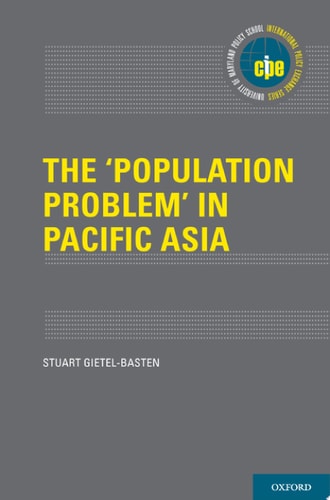
The Population Problem in Pacific Asia
0
0
As an Amazon Associate and affiliate partner, Menrva Books earns from qualifying purchases. Learn more
Author Description
Despite the twenty-first century's often being referred to as the Asian century-indicating hope for economic growth and the rebalancing of the global order-population aging and stagnation present an existential threat to the success of China and other territories of Pacific Asia (namely Japan, Taiwan, Hong Kong, Singapore, and South Korea). This book argues that the population problem, rooted in low fertility, has thus far been largely considered in a linear way: low fertility leads to population stagnation and rapid aging, so fixing low fertility should correct the problem. However, a multi-dimensional lens is essential to appreciating the scale and nature of the issue-and, indeed, to determining whether it is an issue at all. Stuart Gietel-Basten examines how the issue of low fertility has been constructed, how blame has been apportioned, and why policies designed to tackle it have yielded few results. Drawing on an array of primary and secondary sources as well as examples from scholarly and popular literature, The Population Problem in Pacific Asia takes a comparative approach to fertility in the region and locates mainland China in its regional context. It serves as a useful resource for government workers, stakeholders, and students and scholars in sociology, demography, geography, economics, and area studies.
Menrva's Summary
THE THESIS
This book investigates whether the demographic shifts of low fertility, aging populations, and stagnation in Pacific Asia constitute an existential threat or a misunderstood phenomenon. Stuart Gietel-Basten, a scholar in social policy and demography, challenges the conventional linear narrative that low fertility is a singular problem requiring simple policy fixes. By analyzing the construction of the 'population problem' across China, Japan, South Korea, Taiwan, Hong Kong, and Singapore, the author argues that current policy interventions fail because they ignore the multi-dimensional nature of the issue. The work provides a comparative framework to understand how these societies define and respond to demographic change.
THE SCOPE MAP
What You Will Find
- Comparative analysis of fertility trends across China, Japan, South Korea, Taiwan, Hong Kong, and Singapore.
- Examination of how political and social discourse constructs the 'population problem' and assigns blame.
- Evaluation of the efficacy of existing government policies designed to boost fertility rates.
- Synthesis of primary and secondary data, including scholarly research and popular media representations.
THE AUTHORITY PERSPECTIVE
Experts recognize this work as a critical intervention in demographic studies, particularly for its refusal to accept simplistic solutions to complex social trends. Readers frequently note the academic rigor of the text, making it a foundational resource for students and policymakers interested in the future of East Asian social structures.
Page Count:
224
Publication Date:
2019-01-01
Publisher:
Oxford University Press
ISBN-10:
0199361088
ISBN-13:
9780199361083
Economics
Sociology
Geography
Asian Studies
Demography
Community Tags
Similar Books