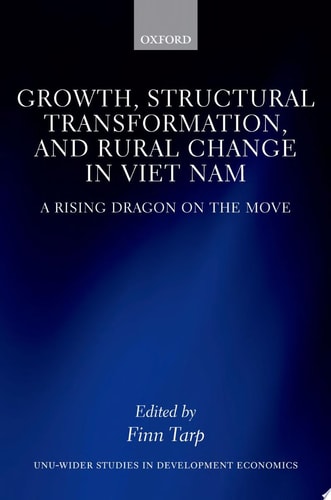
Growth, Structural Transformation, and Rural Change in Viet Nam
0
0
As an Amazon Associate and affiliate partner, Menrva Books earns from qualifying purchases. Learn more
Author Description
This is an open access title available under the terms of a CC BY-NC-SA 3.0 IGO licence. It is free to read at Oxford Scholarship Online and offered as a free PDF download from OUP and selected open access locations. Many developing countries-Viet Nam included-continue to struggle to raise incomes per capita. A common feature of the growth and development process is a fundamental change in the pattern of economic activity, as households reallocate labour from traditional agriculture to more productive forms of agriculture and modern industrial and service sectors. Broad structural transformation and widespread poverty reduction is the combined result of these large-scale shifts in work and labour allocation when they realise desired development goals. The roots of this volume grow from when the first pilot Viet Nam Access to Resources Household Survey (VARHS) was carried out in 2002. The success of this inspired the Central Institute of Economic Management (CIEM) in Hanoi, the Institute of Policy and Strategy for Agriculture and Rural Development (CAP-IPSARD), the Institute of Labour Science and Social Affairs (ILSSA), and the Development Economics Research Group (DERG) of the University of Copenhagen, together with Danida and later on UNU-WIDER, to plan and carry out a more ambitious VARHS from 2006, increasing coverage and representativeness to more than 2,150 families and 12 provinces across the various regions of Viet Nam. The VARHS covering these very same households had by 2014 been carried out five times, i.e. every two years. It is on this high quality panel data foundation and almost 15 years of study and policy work using the VARHS data the present volume builds, in its effort to bring out the essential rural micro-economic characteristics and insights of a dynamic South-east Asian economy in transition from a centrally planned towards a more market based economy.
Menrva's Summary
THE THESIS
This volume investigates the mechanisms of economic growth and structural transformation in Vietnam, specifically focusing on how rural households adapt to a transition from a centrally planned to a market-based economy. Edited by Finn Tarp, the work synthesizes nearly 15 years of longitudinal research derived from the Viet Nam Access to Resources Household Survey (VARHS). The contributors analyze how the reallocation of labor from traditional agriculture to modern industrial and service sectors serves as a primary driver for poverty reduction and income growth.
THE SCOPE MAP
What You Will Find
- Longitudinal panel data covering over 2,150 households across 12 Vietnamese provinces.
- Analysis of labor reallocation patterns between agricultural and non-agricultural sectors.
- Evaluation of household resource access and economic mobility over a decade of transition.
- Collaborative research findings from the Central Institute of Economic Management and the University of Copenhagen.
Scope Limits
- The study focuses primarily on rural micro-economic characteristics rather than national-level macroeconomic policy.
- The findings are specific to the Vietnamese context and may not be universally applicable to all developing economies.
THE AUTHORITY PERSPECTIVE
Experts identify this volume as a critical resource for understanding the micro-foundations of Vietnam's economic transition. Researchers frequently cite the VARHS panel data as a high-quality empirical basis for evaluating rural development and poverty alleviation strategies in Southeast Asia.
Page Count:
352
Publication Date:
2017-01-01
Publisher:
Oxford University Press
ISBN-10:
0192517295
ISBN-13:
9780192517296
Economics
Sociology
Asian Studies
Public Policy
Community Tags
Similar Books