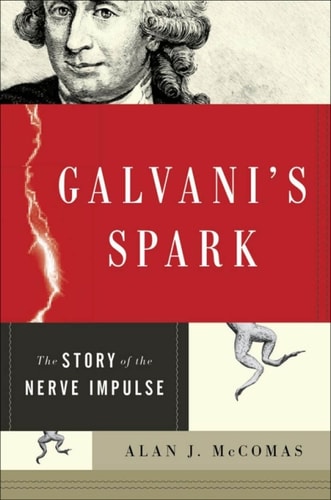
Galvani's Spark: The Story of the Nerve Impulse
0
0
As an Amazon Associate and affiliate partner, Menrva Books earns from qualifying purchases. Learn more
Author Description
Galvani's Spark chronicles the gradual understanding of the nerve impulse which is the basis of all thoughts, sensations and actions. The story begins with Luigi Galvani's chance observation of a spark from a friction machine causing a frog's leg to twitch from across the room. The accurate recording and the understanding of the properties of the nerve fiber membrane that makes the impulse possible became the objectives of neuroscientists for over 200 years. The author, Alan J. McComas finely interweaves the stories, the challenges, and the controversies of the most prominent figures in neuroscience, from the histological descriptions of nerve cells by Cajal to the discovery of a three-dimensional structure of ion channels in cell membranes by MacKinnon. Along the way he details the first recordings of the impulse with a cathode ray oscilloscope by Gasser and Erlanger, Adrian's discovery that stimulus intensity is coded by the frequency of nerve impulses, and Hodgkin and Huxley's brilliant voltage clamp experiments, amongst many others. The recognition by Galvani that muscles and nerves have an electrical component triggered the field of neurophysiology and in turn has produced some of the greatest discoveries in neuroscience. 16 investigators of the nerve impulse went on to win or share Nobel prizes and this book not only emphasizes their work but also traces their brilliant careers. For anyone interested in the nervous system and the history of neuroscience, Galvani's Spark: The Story of the Nerve Impulse is essential reading.
Menrva's Summary
THE THESIS
This book investigates the historical progression of scientific understanding regarding the nerve impulse, tracing the evolution of neurophysiology from early electrical experiments to modern molecular discoveries. Author Alan J. McComas, a specialist in the field, synthesizes over two centuries of research to explain how the nerve fiber membrane functions as the foundation for all human thought, sensation, and action. He utilizes the biographies of prominent researchers to frame the technical advancements that defined the discipline. The work argues that the field of neurophysiology is built upon a cumulative series of experimental breakthroughs and intense intellectual controversies.
THE SCOPE MAP
What You Will Find
- Historical analysis of neurophysiological milestones from Luigi Galvani to modern ion channel research.
- Detailed accounts of experimental methodologies including voltage clamp techniques and cathode ray oscilloscope recordings.
- Biographical profiles of 16 Nobel Prize-winning investigators who shaped the study of the nervous system.
- Technical explanations of nerve fiber membrane properties and the coding of stimulus intensity.
THE AUTHORITY PERSPECTIVE
Experts and readers frequently note the book's ability to balance complex technical history with accessible biographical narratives. It is widely regarded as a comprehensive resource for those seeking to understand the foundational developments in the history of neuroscience.
Page Count:
416
Publication Date:
2011-01-01
Publisher:
Oxford University Press
ISBN-10:
0199395950
ISBN-13:
9780199395958
History
Science
Biography
Nervous System
Allied Health
Neuroscience
Biology
Medical
Community Tags
Similar Books