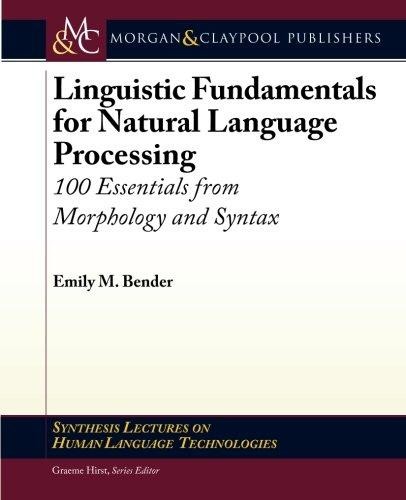
Linguistic Fundamentals for Natural Language Processing: 100 Essentials from Morphology and Syntax
0
0
As an Amazon Associate and affiliate partner, Menrva Books earns from qualifying purchases. Learn more
Author Description
Many NLP tasks have at their core a subtask of extracting the dependencies--who did what to whom--from natural language sentences. This task can be understood as the inverse of the problem solved in different ways by diverse human languages, namely, how to indicate the relationship between different parts of a sentence. Understanding how languages solve the problem can be extremely useful in both feature design and error analysis in the application of machine learning to NLP. Likewise, understanding cross-linguistic variation can be important for the design of MT systems and other multilingual applications. The purpose of this book is to present in a succinct and accessible fashion information about the morphological and syntactic structure of human languages that can be useful in creating more linguistically sophisticated, more language-independent, and thus more successful NLP systems.
Menrva's Summary
THE THESIS
This book investigates the fundamental linguistic principles underlying natural language processing, focusing on morphology and syntax to enhance NLP system design. The author, Emily M. Bender, a recognized expert in the field, aims to bridge the gap between linguistic theory and computational applications. By examining how human languages encode sentence relationships, the book provides insights crucial for feature engineering and error analysis in machine learning for NLP. It also highlights the importance of cross-linguistic variation for developing robust multilingual systems.
THE SCOPE MAP
- Core concepts in morphology and syntax relevant to NLP.
- Explanations of how languages indicate relationships between sentence parts.
- Applications of linguistic knowledge to feature design in machine learning.
- Insights into error analysis for NLP systems.
- Discussion of cross-linguistic variation for MT and multilingual applications.
- Strategies for creating more linguistically sophisticated and language-independent NLP systems.
THE AUTHORITY PERSPECTIVE
The book is positioned as an essential resource for NLP practitioners seeking to integrate deeper linguistic understanding into their work. Its focus on fundamental principles suggests it serves as a valuable reference for both theoretical grounding and practical application in areas like feature engineering and error analysis. The emphasis on cross-linguistic variation indicates its utility for those developing multilingual NLP systems. The accessible presentation aims to make complex linguistic concepts available to a broader audience within the NLP community.
Page Count:
0
Publication Date:
2013-01-01
ISBN-10:
3031010221
ISBN-13:
9783031010224
Science
Non-Fiction
Science & Technology
Linguistics
Computational linguistics
Syntax
Morphology
Community Tags
Similar Books