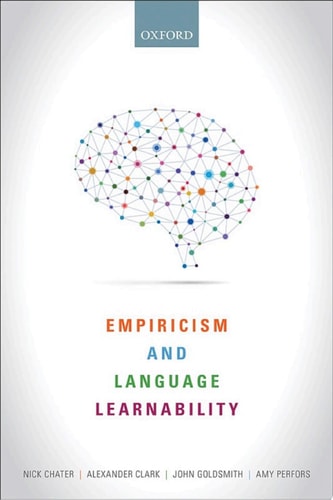
Empiricism and Language Learnability
0
0
As an Amazon Associate and affiliate partner, Menrva Books earns from qualifying purchases. Learn more
Author Description
This interdisciplinary new work explores one of the central theoretical problems in linguistics: learnability. The authors, from different backgrounds---linguistics, philosophy, computer science, psychology and cognitive science-explore the idea that language acquisition proceeds through general purpose learning mechanisms, an approach that is broadly empiricist both methodologically and psychologically. For many years, the empiricist approach has been taken to be unfeasible on practical and theoretical grounds. In the book, the authors present a variety of precisely specified mathematical and computational results that show that empiricist approaches can form a viable solution to the problem of language acquisition. It assumes limited technical background and explains the fundamental principles of probability, grammatical description and learning theory in an accessible and non-technical way. Different chapters address the problem of language acquisition using different assumptions: looking at the methodology of linguistic analysis using simplicity based criteria, using computational experiments on real corpora, using theoretical analysis using probabilistic learning theory, and looking at the computational problems involved in learning richly structured grammars. Written by four researchers in the full range of relevant fields: linguistics (John Goldsmith), psychology (Nick Chater), computer science (Alex Clark), and cognitive science (Amy Perfors), the book sheds light on the central problems of learnability and language, and traces their implications for key questions of theoretical linguistics and the study of language acquisition.
Menrva's Summary
THE THESIS
Can language acquisition be explained through general-purpose learning mechanisms rather than innate linguistic structures? The authors, representing expertise in linguistics, psychology, computer science, and cognitive science, argue that empiricist approaches to language learning are mathematically and computationally viable. By synthesizing diverse research methodologies, they challenge the long-standing assumption that such models are insufficient to account for the complexity of human language development.
THE SCOPE MAP
What You Will Find
- Mathematical and computational models of language learnability
- Applications of probability and learning theory to grammatical description
- Analysis of simplicity-based criteria in linguistic methodology
- Computational experiments utilizing real-world language corpora
Scope Limits
- The text assumes a limited technical background and avoids highly specialized jargon
- It does not provide an exhaustive history of nativist linguistic theories
THE AUTHORITY PERSPECTIVE
Experts recognize this work as a significant interdisciplinary contribution that bridges the gap between theoretical linguistics and computational learning theory. Readers frequently note that the authors successfully translate complex mathematical concepts into accessible prose for students and researchers across the cognitive sciences.
Page Count:
267
Publication Date:
2015-01-01
Publisher:
OUP Oxford
ISBN-10:
0191053597
ISBN-13:
9780191053597
Psychology
Linguistics
Philosophy of
Computational linguistics
Community Tags
Other Editions(2)

Similar Books










Reader Comments
Share Your Thoughts
No comments yet. Be the first to share your thoughts!