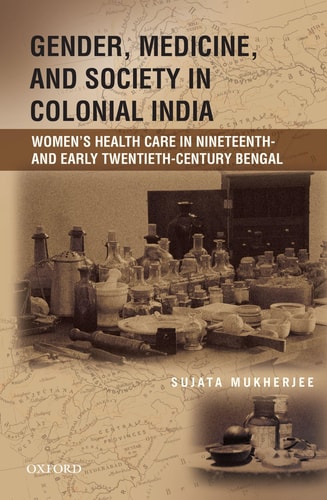
Gender, Medicine, and Society in Colonial India: Women's Health Care in Nineteenth- and Early Twentieth-Century Bengal
0
0
As an Amazon Associate and affiliate partner, Menrva Books earns from qualifying purchases. Learn more
Author Description
British imperialism in India left in its wake the scars of many battles between the colonizer and the colonized. Intense hostilities were witnessed as each tried to prove its superiority in domains such as medicine, education, and law. Through the lens of gender politics, Sujata Mukherjee confronts these conflicts to reveal the contested 'body' of the Indian woman.Focusing on hospital medicine and preventive medical care, Mukherjee traces the popularization of Western forms of medical care in nineteenth- and early twentieth-century Bengal. She shows how it created a space-albeit small-for providing Western health care to female patients; for the first time, women could receive medical attention outside the purdah and zenana. However, there was a simultaneous discrediting of indigenous forms of medicine-such as Ayurveda and Unani-and their practitioners, who had once exercised significant influence.The book also explores the growth of Western medical education among women in Bengal. Overcoming racial and gender discrimination, social taboos, and active opposition from authorities and their families, some remarkable women became doctors and practicing physicians. Aiding them in their long-drawn efforts were the Brahmo Samaj and several women's organizations and agencies of the time.
Menrva's Summary
THE THESIS
This book investigates the intersection of gender, colonial power, and medical practice in Bengal to determine how Western medicine reshaped the lives and social status of Indian women. Sujata Mukherjee, a scholar of social history, utilizes archival records and historical analysis to examine the transition from indigenous medical systems to colonial health frameworks. She argues that the introduction of Western medicine served as a site of intense cultural negotiation, where gender politics and imperial authority converged to marginalize traditional practitioners while simultaneously opening new professional avenues for women.
THE SCOPE MAP
What You Will Find
- Analysis of the shift from traditional Ayurveda and Unani practices to Western hospital medicine.
- Examination of the social and institutional barriers faced by early female medical students in Bengal.
- Case studies on the role of the Brahmo Samaj and women's organizations in promoting female education.
- Historical documentation of the tension between colonial medical policies and the cultural norms of the purdah and zenana.
THE AUTHORITY PERSPECTIVE
Scholars in the field of South Asian history recognize this work as a significant contribution to the study of colonial medical discourse and gendered social structures. Readers frequently note the academic density of the prose and the extensive use of primary source material to support the author's arguments.
Page Count:
260
Publication Date:
2017-03-01
Publisher:
Oxford University Press
ISBN-10:
0199468222
ISBN-13:
9780199468225
History
Social History
Women india
Medicine
Women
Gender Studies
Colonial India
Community Tags
Similar Books