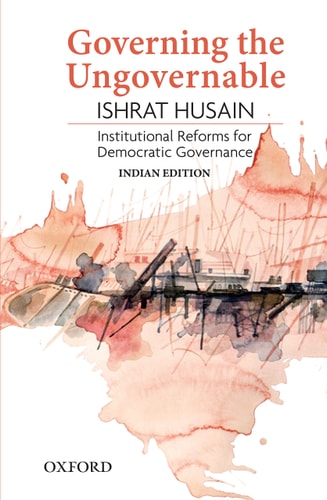
Governing the Ungovernable
0
0
As an Amazon Associate and affiliate partner, Menrva Books earns from qualifying purchases. Learn more
Author Description
Pakistan, since its independence in 1947, had to face tumultuous years for the first four decades. Despite the many challenges, both internal and external, the country was able to register a 6 per cent average annual growth rate during the first forty years of its existence. The country was ahead of India and Bangladesh in all economic and social indicators. Since 1990, the country has fallen behind its neighbouring countries and has had a decline in the growth rate.This book attempts to examine the reasons behind this slowdown, the volatile and inequitable growth of the last twenty-five years, and through a process of theoretical and empirical evidence argues that the most powerful explanatory hypothesis lies in the decay of institutions of governance. It also suggests a selective and incremental approach of restructuring some key public institutions that pertain to accountability, transparency, security, economic growth, and equity.
Menrva's Summary
THE THESIS
This book investigates the institutional decay responsible for Pakistan's economic stagnation and decline relative to its neighbors since 1990. Ishrat Husain, a former Governor of the State Bank of Pakistan, utilizes his extensive background in public administration and economic policy to analyze the country's trajectory. By synthesizing historical data with empirical evidence, he argues that the erosion of governance structures is the primary factor hindering sustainable development and equitable growth.
THE SCOPE MAP
What You Will Find
- A comparative analysis of Pakistan's economic performance from 1947 to the present.
- An evaluation of institutional frameworks governing accountability, transparency, and security.
- Empirical evidence linking institutional degradation to volatile economic growth rates.
- A proposed incremental strategy for restructuring key public institutions to restore economic stability.
THE AUTHORITY PERSPECTIVE
Experts and policy analysts recognize this work as a significant contribution to the study of South Asian political economy. Readers frequently note the author's pragmatic approach to institutional reform and his deep familiarity with the internal mechanics of the Pakistani state.
Page Count:
0
Publication Date:
1900-01-01
Publisher:
Oxford
ISBN-10:
0199494045
ISBN-13:
9780199494040
Economics
History
Public Policy
Community Tags
Similar Books