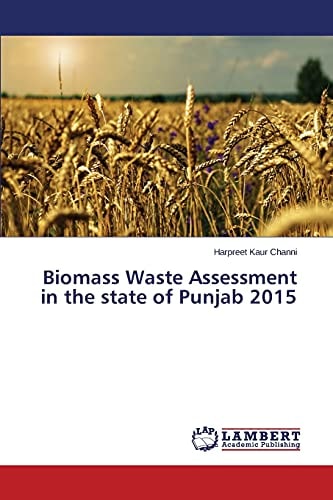
Biomass Waste Assessment in the State of Punjab 2015
0
0
As an Amazon Associate and affiliate partner, Menrva Books earns from qualifying purchases. Learn more
Author Description
Energy plays most important role in our life. Without energy we can't imagine our life. Both conventional and non-conventional energy resources are important for power production. According to world energy forum, the conventional energy sources will be depleted in few decades. In India 65% of power is generated from fossil fuel based power plants. As the fossil fuels are fast depleting, these needs to be replaced by non- renewable sources viz wind, solar, agri waste, tidal, geothermal etc. India is an agricultural based country. Agri waste available in the country is in abundance. Agri waste is available even after using it as domestic fuel, fodder and thatching. Environmental pollution resulting from the burning of agricultural waste in the atmosphere is one of the causes of increasing global warming. So it is better to make efforts in the direction of utilizing this waste. The present work makes an effort in the same direction. Availability of surplus biomass is calculated to find out the available power potential in the state of Punjab. For this all 22 districts are studied to check the biomass availability during one year.
Menrva's Summary
THE THESIS
This study quantifies the potential for biomass energy generation from agricultural waste in Punjab, India, to address the nation's growing energy demands and mitigate environmental pollution. The research examines the abundance of agricultural waste in Punjab, a predominantly agricultural state, as a viable non-conventional energy source to supplement depleting fossil fuels. It details a year-long study across all 22 districts to calculate surplus biomass availability and assess its power generation potential, aiming to provide a sustainable energy solution.
THE SCOPE MAP
- Assessment of agricultural waste availability across all 22 districts of Punjab.
- Calculation of surplus biomass after domestic use and fodder provision.
- Estimation of the power generation potential from available agri-waste.
- Analysis of environmental pollution and global warming impacts from agricultural waste burning.
- Exploration of non-conventional energy sources as alternatives to fossil fuels.
- Focus on the state of Punjab as a case study for biomass energy potential.
THE AUTHORITY PERSPECTIVE
The study provides a detailed assessment of biomass waste in Punjab, focusing on its potential for energy generation. It highlights the environmental concerns associated with agricultural waste burning and proposes utilizing this waste as a non-conventional energy source. The research offers a data-driven approach to understanding regional energy potential, contributing to discussions on sustainable energy solutions in India.
Page Count:
112
Publication Date:
2015-01-01
Publisher:
Lap Lambert Academic Publishing GmbH KG
ISBN-10:
3659548146
ISBN-13:
9783659548147
Non-Fiction
Science
Energy
Agriculture
Community Tags
Similar Books














