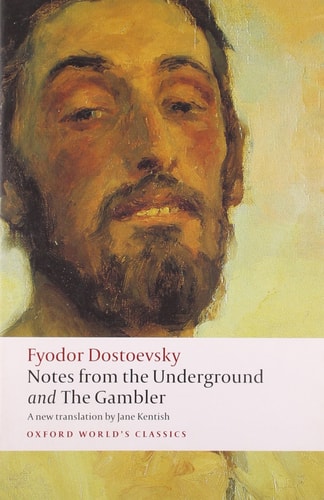
Notes from Underground
0
0
As an Amazon Associate and affiliate partner, Menrva Books earns from qualifying purchases. Learn more
Author Description
One of the most profound and disturbing works of nineteenth-century literature, Notes from the Underground is a probing and speculative work, often regarded as a forerunner to the Existentialist movement. The Gambler explores the compulsive nature of gambling, one of Dostoevsky's own vices and a subject he describes with extraordinary acumen and drama. Both works are new translations, specially commissioned for the World's Classics series.About the Series: For over 100 years Oxford World's Classics has made available the broadest spectrum of literature from around the globe. Each affordable volume reflects Oxford's commitment to scholarship, providing the most accurate text plus a wealth of other valuable features, including expert introductions by leading authorities, voluminous notes to clarify the text, up-to-date bibliographies for further study, and much more.
Menrva's Summary
THE PULSE
A bitter, isolated former civil servant retreats into a self-imposed exile to confront the contradictions of human consciousness and the failure of rationalism. The protagonist, known only as the Underground Man, rejects the societal norms of nineteenth-century St. Petersburg, choosing instead to wallow in his own spite and intellectual superiority. His objective is to dismantle the prevailing belief in progress and logic, viewing them as constraints on the chaotic nature of human free will. The narrative is presented as a first-person confession, characterized by a non-linear structure that oscillates between philosophical diatribes and fragmented memories of past social interactions.
INSIDE THE PAGES
- First-person confessional narrative style
- Exploration of psychological alienation and spite
- Critique of rational egoism and utopian idealism
- Unreliable narrator who frequently contradicts his own logic
- Vivid depiction of nineteenth-century St. Petersburg social strata
- Philosophical inquiry into the nature of free will
- Introspective monologues that challenge the reader's moral assumptions
- Satirical tone directed at contemporary intellectual trends
THE COLLECTIVE ECHO
Readers and critics frequently identify this work as a foundational text for existentialist thought, noting its intense focus on the internal contradictions of the human psyche. Discussion often centers on the narrator's abrasive personality and his refusal to conform to the social expectations of his time. Many observers highlight the effectiveness of the author's prose in capturing the claustrophobic atmosphere of the protagonist's underground existence. The balance between philosophical argument and character-driven narrative remains a primary point of interest for those examining the evolution of modern psychological fiction.
Page Count:
262
Publication Date:
1969-01-01
Publisher:
T. Y. Crowell Co
ISBN-10:
0199536384
ISBN-13:
9780199536382
Russian
classic
Psychological
Philosophical
Existentialism
Community Tags
Other Editions(9)






Similar Books












Reader Comments
Share Your Thoughts
No comments yet. Be the first to share your thoughts!