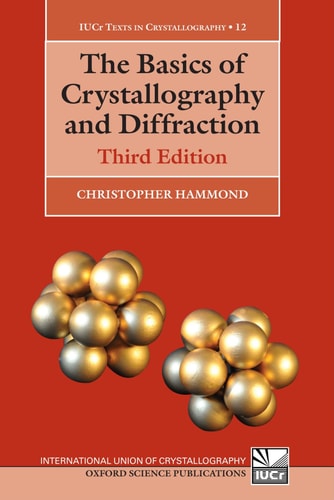
The Basics of Crystallography and Diffraction
0
0
As an Amazon Associate and affiliate partner, Menrva Books earns from qualifying purchases. Learn more
Author Description
This book provides a clear introduction to topics which are essential to students in a wide range of scientific disciplines but which are otherwise only covered in specialised and mathematically detailed texts. It shows how crystal structures may be built up from simple ideas of atomic packing and co-ordination, it develops the concepts of crystal symmetry, point and space groups by way of two dimensional examples of patterns and tilings, it explains the concept of the reciprocal lattice in simple terms and shows its importance in an understanding of light, X-ray and electron diffraction. Practical examples of the applications of these techniques are described and also the importance of diffraction in the performance of optical instruments.The book is also of value to the general reader since it shows, by biographical and historical references, how the subject has developed and thereby indicates some of the excitement of scientific discovery.
Menrva's Summary
THE THESIS
This text investigates the fundamental principles of crystallography and diffraction, aiming to bridge the gap between introductory concepts and highly specialized mathematical treatises. Christopher Hammond, an expert in the field, utilizes a pedagogical approach that prioritizes conceptual clarity over dense formalism. By integrating historical context with structural analysis, the book provides a framework for understanding how atomic arrangements dictate the physical properties of materials and the behavior of diffraction patterns.
THE SCOPE MAP
What You Will Find
- Atomic packing and coordination principles
- Symmetry, point groups, and space groups using two-dimensional patterns
- Reciprocal lattice theory and its application to light, X-ray, and electron diffraction
- Historical and biographical context of scientific discovery in crystallography
THE AUTHORITY PERSPECTIVE
Experts and educators frequently cite this work as a foundational text for students transitioning into materials science and solid-state physics. Readers often note that the prose remains accessible while maintaining the technical rigor required for undergraduate study.
Page Count:
432
Publication Date:
2009-06-15
Publisher:
Oxford University Press
ISBN-10:
0199546452
ISBN-13:
9780199546459
Science
Physics
textbook
Chemistry
Community Tags
Other Editions(8)




Similar Books









Reader Comments
Share Your Thoughts
No comments yet. Be the first to share your thoughts!