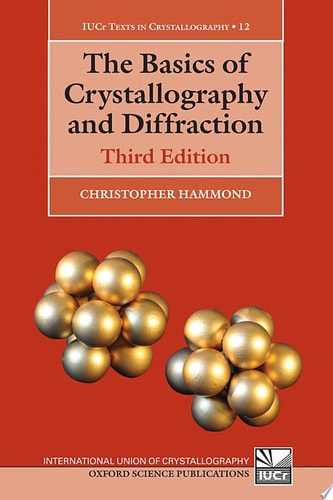
The Basics of Crystallography and Diffraction
0
0
As an Amazon Associate and affiliate partner, Menrva Books earns from qualifying purchases. Learn more
Author Description
This Book Provides A Clear Introduction To Topics Which Are Essential To Students In A Wide Range Of Scientific Disciplines But Which Are Otherwise Only Covered In Specialised And Mathematically Detailed Texts. It Shows How Crystal Structures May Be Built Up From Simple Ideas Of Atomic Packing And Co-ordination, It Develops The Concepts Of Crystal Symmetry, Point And Space Groups By Way Of Two Dimensional Examples Of Patterns And Tilings, It Explains The Concept Of The Reciprocal Lattice In Simple Terms And Shows Its Importance In An Understanding Of Light, X-ray And Electron Diffraction. Practical Examples Of The Applications Of These Techniques Are Described And Also The Importance Of Diffraction In The Performance Of Optical Instruments. The Book Is Also Of Value To The General Reader Since It Shows, By Biographical And Historical References, How The Subject Has Developed And Thereby Indicates Some Of The Excitement Of Scientific Discovery.
Menrva's Summary
THE THESIS
How can the complex principles of crystallography and diffraction be made accessible to students across diverse scientific disciplines without relying on overly dense mathematical abstraction? Christopher Hammond, a respected educator in materials science, addresses this by stripping away the excessive technical jargon found in specialized literature. He utilizes a pedagogical framework that builds from fundamental concepts of atomic packing and symmetry to more advanced applications in X-ray and electron diffraction, ensuring the material remains grounded in physical intuition rather than pure calculation.
THE SCOPE MAP
What You Will Find
- Foundational concepts of atomic packing and co-ordination
- Development of crystal symmetry, point groups, and space groups using two-dimensional patterns
- Simplified explanations of the reciprocal lattice and its role in diffraction
- Historical and biographical context of scientific discovery in the field
Scope Limits
- Does not provide the exhaustive mathematical derivations found in advanced graduate-level monographs
- Focuses primarily on introductory principles rather than specialized industrial research applications
THE AUTHORITY PERSPECTIVE
Experts frequently cite this work as a foundational text for undergraduates and general readers seeking a conceptual entry point into diffraction studies. Readers often note that the prose is remarkably clear and avoids the intimidating density typical of advanced crystallography manuals.
Page Count:
448
Publication Date:
2009-01-01
Publisher:
Oup Oxford
ISBN-10:
019156771X
ISBN-13:
9780191567711
Science
Academic Textbooks
Chemistry
Physics
Community Tags
Other Editions(8)





Similar Books











Reader Comments
Share Your Thoughts
No comments yet. Be the first to share your thoughts!