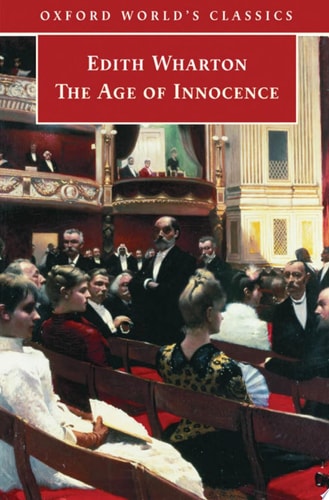
The Age of Innocence
0
0
As an Amazon Associate and affiliate partner, Menrva Books earns from qualifying purchases. Learn more
Author Description
The Age of Innocence, Edith Wharton's most famous novel, is a love story, written immediately after the end of the First World War. Its brilliant anatomization of the snobbery and hypocrisy of the wealthy elite of New York society in the 1870s made it an instant classic, and it won the Pulitzer Prize in 1921. Newland Archer, Wharton's protagonist, charming, tactful, enlightened, is a thorough product of this society; he accepts its standards and abides by its rules but he also recognizes its limitations. His engagement to the impeccable May Welland assures him of a safe and conventional future, until the arrival of May's cousin Ellen Olenska. Independent, free-thinking, scandalously separated from her husband, Ellen forces Archer to question the values and assumptions of his narrow world. As their love for each other grows, Archer has to decide where his ultimate loyalty lies.Stephen Orgel's introduction and notes set the novel in the context of the period and discusses Wharton's skilfull weaving of characters and plot, her anthropological exactitude, and the novel's autobiographical overtones.About the Series: For over 100 years Oxford World's Classics has made available the broadest spectrum of literature from around the globe. Each affordable volume reflects Oxford's commitment to scholarship, providing the most accurate text plus a wealth of other valuable features, including expert introductions by leading authorities, voluminous notes to clarify the text, up-to-date bibliographies for further study, and much more.
Menrva's Summary
THE PULSE
Newland Archer faces a profound moral crisis when his desire for an unconventional woman threatens to dismantle his carefully constructed life within the rigid confines of 1870s New York high society. Archer, a man defined by his adherence to the social codes of his elite circle, finds his predictable future with the virtuous May Welland destabilized by the arrival of the free-spirited Ellen Olenska. As he navigates the suffocating expectations of his peers, he must weigh his personal fulfillment against the crushing weight of social duty. The narrative employs a third-person limited perspective that emphasizes the internal conflict of a man trapped by the very traditions he once championed.
INSIDE THE PAGES
- Detailed examination of Gilded Age social hierarchies and etiquette
- Use of irony to critique the hypocrisy of the wealthy elite
- Focus on the tension between individual desire and collective social obligation
- Precise, observational prose style characteristic of late 19th-century realism
- Exploration of the limitations placed upon women within high society
- Symbolic use of setting and material culture to reflect character internal states
- Non-linear emotional progression that mirrors the protagonist's growing disillusionment
- Anthropological approach to describing the rituals of the New York aristocracy
THE COLLECTIVE ECHO
Readers and critics frequently highlight the novel's meticulous attention to the subtle power dynamics of 19th-century social circles. Discussion often centers on the effectiveness of Wharton's prose in capturing the suffocating atmosphere of a society that prioritizes appearance over authenticity. Many observers note the balance between the internal psychological development of Newland Archer and the external pressures exerted by his environment. The work is widely recognized for its sharp critique of class structures and the personal cost of conformity. Readers often find the ending particularly resonant due to its quiet, understated resolution of the central romantic conflict.
Page Count:
278
Publication Date:
2008-12-15
Publisher:
Oxford University Press
ISBN-10:
0199540012
ISBN-13:
9780199540013
Romance
Married People
New York
Social Commentary
English
Man-woman relationships
English & College Success
classic
Historical
Realism
Community Tags
Other Editions(61)
Book Sales, Incorporated
2026
Default edition
Alicia Editions
2024

BoD - Books on Demand
2023
Digibooks OOD
2022

Independently Published
2021

Independently Published
2021

Mint Editions
2021

Amazon Digital Services LLC - KDP Print US
2021

Mint Editions
2021
Independently Published
2021

Independently Published
2020

Independently Published
2020
Independently Published
2019
Astral International Pvt. Limited
2019
Pan Macmillan
2019
Oxford University Press España, S.A.
2018

Barnes & Noble Press
2018

CreateSpace Independent Publishing Platform
2017

CreateSpace Independent Publishing Platform
2017

CreateSpace Independent Publishing Platform
2017
CreateSpace Independent Publishing Platform
2017
CreateSpace Independent Publishing Platform
2017
CreateSpace Independent Publishing Platform
2017
Little, Brown Book Group
2017

CreateSpace Independent Publishing Platform
2017

CreateSpace Independent Publishing Platform
2016

CreateSpace Independent Publishing Platform
2016

CreateSpace Independent Publishing Platform
2016

CreateSpace Independent Publishing Platform
2016

CreateSpace Independent Publishing Platform
2016

CreateSpace Independent Publishing Platform
2016
CreateSpace Independent Publishing Platform
2016

CreateSpace Independent Publishing Platform
2016
CreateSpace Independent Publishing Platform
2016

CreateSpace Independent Publishing Platform
2015
CreateSpace Independent Publishing Platform
2015

CreateSpace Independent Publishing Platform
2015
CreateSpace Independent Publishing Platform
2014

Canterbury Classics
2014

CreateSpace Independent Publishing Platform
2014
Oxford University Press
2012

HarperCollins Publishers Limited
2010
Oxford University Press
2009

Wheeler Pub.
2009
Oxford University Press
2008

Random House UK
2008
Oxford University Press
2008
Oxford University Press
2008

HV Publishign, a division of Homepage Ventures, Limited
2008
Random House Publishing Group
2008

Penguin Group USA, Inc.
2008

BBC Audiobooks
2008
Oxford University Press
2007

Echo Library
2006

ICON Classics
2005

Barnes & Noble World Digital Library
2003
North Books
1999
Brilliance Corp
1997

Penguin
1996
Penguin Books
1974
CreateSpace Independent Publishing Platform
1953
Similar Books
Reader Comments
Share Your Thoughts
No comments yet. Be the first to share your thoughts!