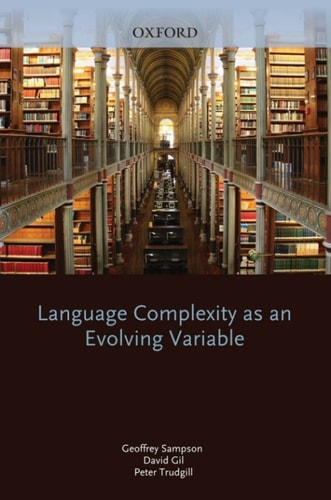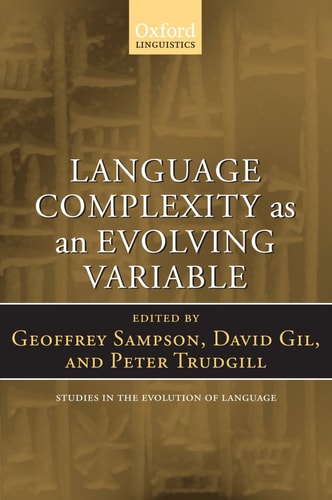
Language Complexity as an Evolving Variable
0
0
As an Amazon Associate and affiliate partner, Menrva Books earns from qualifying purchases. Learn more
Author Description
This book presents a challenge to the widely-held assumption that human languages are both similar and constant in their degree of complexity. For a hundred years or more the universal equality of languages has been a tenet of faith among most anthropologists and linguists. It has been frequently advanced as a corrective to the idea that some languages are at a later stage of evolution than others. It also appears to be an inevitable outcome of one of the central axioms of generative linguistic theory: that the mental architecture of language is fixed and is thus identical in all languages and that whereas genes evolve languages do not.Language Complexity as an Evolving Variable reopens the debate. Geoffrey Sampson's introductory chapter re-examines and clarifies the notion and theoretical importance of complexity in language, linguistics, cognitive science, and evolution. Eighteen distinguished scholars from all over the world then look at evidence gleaned from their own research in order to reconsider whether languages do or do not exhibit the same degrees and kinds of complexity. They examine data from a wide range of times and places. They consider the links between linguistic structure and social complexity and relate their findings to the causes and processes of language change. Their arguments are frequently controversial and provocative; their conclusions add up to an important challenge to conventional ideas about the nature of language.The authors write readably and accessibly with no recourse to unnecessary jargon. This fascinating book will appeal to all those interested in the interrelations between human nature, culture, and language.
Menrva's Summary
THE THESIS
This book investigates the long-standing assumption of universal linguistic equality by questioning whether human languages maintain a constant and identical degree of complexity. The authors, including David Gil, Geoffrey Sampson, and Peter Trudgill, challenge the generative linguistic axiom that mental language architecture is fixed. By assembling research from eighteen international scholars, the text argues that linguistic complexity is an evolving variable influenced by social structures and historical processes rather than a static universal trait.
THE SCOPE MAP
What You Will Find
- Comparative analysis of linguistic structures across diverse global cultures and historical periods.
- Theoretical frameworks for defining and measuring complexity in cognitive science and linguistics.
- Empirical evidence linking social complexity to the evolution of grammatical and phonological systems.
- Critical re-evaluations of the generative theory regarding the fixed nature of language.
THE AUTHORITY PERSPECTIVE
Experts recognize this volume as a significant contribution to the ongoing debate regarding linguistic evolution and the validity of the universal equality hypothesis. Readers frequently note that the prose remains accessible and avoids excessive jargon, making it a valuable resource for both professional linguists and students of cultural evolution.
Page Count:
336
Publication Date:
2009-05-15
Publisher:
Oxford University Press
ISBN-10:
0199545227
ISBN-13:
9780199545223
Anthropology
Evolutionary Biology
Linguistics