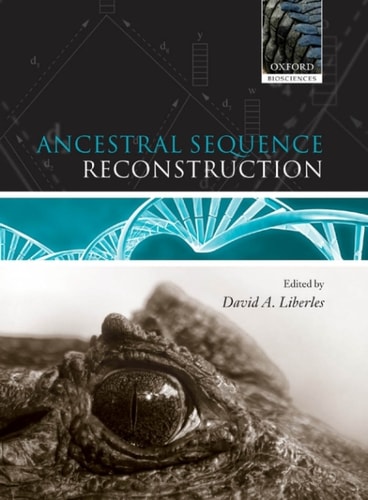
Ancestral Sequence Reconstruction
0
0
As an Amazon Associate and affiliate partner, Menrva Books earns from qualifying purchases. Learn more
Author Description
Ancestral sequence reconstruction is a technique of growing importance in molecular evolutionary biology and comparative genomics. As a powerful tool for testing evolutionary and ecological hypotheses, as well as uncovering the link between sequence and molecular phenotype, there are potential applications in a range of fields. Ancestral Sequence Reconstruction starts with a historical overview of the field, before discussing the potential applications in drug discovery and the pharmaceutical industry. This is followed by a section on computational methodology, which provides a detailed discussion of the available methods for reconstructing ancestral sequences (including their advantages, disadvantages, and potential pitfalls). Purely computational applications of the technique are then covered, including whole proteome reconstruction. Further chapters provide a detailed discussion on taking computationally reconstructed sequences and synthesizing them in the laboratory. This book concludes with a description of the scientific questions where experimental ancestral sequence reconstruction has been utilized to provide insights and inform future research. This research level text provides a first synthesis of the theories, methodologies and applications associated with ancestral sequence recognition, while simultaneously addressing many of the hot topics in the field. It will be of interest and use to both graduate students and researchers in the fields of molecular biology, molecular evolution, and evolutionary bioinformatics.
Menrva's Summary
THE THESIS
This text investigates the theoretical foundations, computational methodologies, and practical applications of ancestral sequence reconstruction within the fields of molecular evolution and comparative genomics. David A. Liberles, an expert in evolutionary bioinformatics, synthesizes current research to address how reconstructed sequences serve as tools for testing evolutionary hypotheses and linking molecular phenotypes to genetic sequences. The book provides a comprehensive framework for both computational analysis and laboratory synthesis, bridging the gap between theoretical modeling and experimental validation.
THE SCOPE MAP
What You Will Find
- Historical overview of ancestral sequence reconstruction techniques
- Computational methodologies including advantages, disadvantages, and potential pitfalls
- Applications in drug discovery and pharmaceutical research
- Protocols for laboratory synthesis of computationally reconstructed sequences
- Analysis of whole proteome reconstruction and experimental validation
THE AUTHORITY PERSPECTIVE
This volume is recognized as a foundational synthesis for graduate students and researchers working in molecular biology and evolutionary bioinformatics. Experts highlight the text for its technical depth and its utility in connecting complex computational models to tangible laboratory outcomes.
Page Count:
272
Publication Date:
2008-07-15
Publisher:
Oxford University Press
ISBN-10:
019954557X
ISBN-13:
9780199545575
Science
Evolutionary Biology
Bioinformatics
Evolutionary genetics
Genetics
Biology
Nucleic Acids
Community Tags
Other Editions(3)

Similar Books