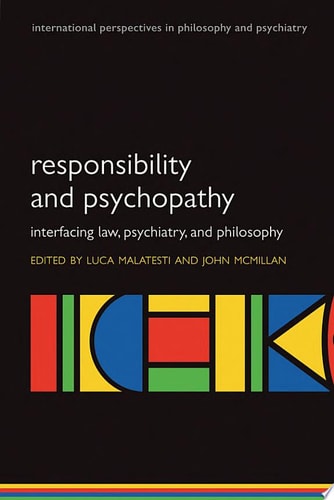
Responsibility and Psychopathy: Interfacing Law, Psychiatry and Philosophy
0
0
As an Amazon Associate and affiliate partner, Menrva Books earns from qualifying purchases. Learn more
Author Description
Psychopaths have emotional impairments that can be expressed in persistent criminal behavior. UK and US law has traditionally excused disordered individuals for their crimes citing these emotional impairments as a cause for their criminal behaviour. The discussion of whether psychopaths are morally responsible for their behaviour has long taken place in the realm of philosophy. However, in recent years, this has moved into scientific and psychiatric investigation, fundamentally so with the development of Robert Hare's diagnostic tool, the Psychopathy Checklist.Responsibility and Psychopathy explores the moral responsibility of psychopaths. It engages with problems at the interface of law, psychiatry, and philosophy, and is divided into three parts providing relevant interdisciplinary background information to address this main problem.The first part discusses the public policy and legal responses to psychopathy. It offers an introduction to the central practical issue of how public policy should respond to psychopathy, giving insights for those arguing about the responsibility of psychopaths.The second part introduces recent scientific advancements in the classification, description, and explanation of psychopathy. In particular, Robert Hare illustrates and defends his Psychopathy Checklist (PCL). Surveys of the most recent brain imaging studies on psychopaths and the prospects for treatment are also included.The third part of the volume includes chapters covering the most significant dimensions of philosophical debate on the moral and criminal responsibility of psychopaths. In relation to this issue, philosophers have considered whether psychopathic offenders possess moral understanding and/or are capable of controlling their criminal behaviour. This part illustrates how answering these questions involves investigating highly debated and central philosophical problems. These difficulties concern the nature of moral understanding, the significance of emotive and cognitive faculties in moral understanding and motivation, and the most appropriate account of moral and criminal responsibility that can justify a response to the psychopathic offenders.Exploring one of the most contentious topics of our time, this book is fascinating reading for psychiatrists, philosophers, criminologists, and lawyers.
Menrva's Summary
THE THESIS
This volume investigates the complex intersection of legal, psychiatric, and philosophical frameworks to determine the moral and criminal responsibility of individuals diagnosed with psychopathy. Editors John McMillan and Luca Malatesti curate a collection of interdisciplinary essays that examine how emotional impairments, as defined by modern diagnostic tools, challenge traditional legal standards of accountability. By synthesizing scientific data with normative philosophical inquiry, the authors provide a structured analysis of whether psychopathic offenders possess the capacity for moral understanding and behavioral control.
THE SCOPE MAP
What You Will Find
- Legal and public policy responses to psychopathic criminal behavior in the UK and US.
- Technical evaluation of the Psychopathy Checklist (PCL) developed by Robert Hare.
- Analysis of neuroscientific evidence, including brain imaging studies and treatment prospects.
- Philosophical debates concerning moral agency, emotive capacity, and the nature of moral understanding.
THE AUTHORITY PERSPECTIVE
Experts identify this text as a foundational interdisciplinary resource for scholars working at the intersection of forensic psychiatry and moral philosophy. Readers frequently note the academic density of the prose, which requires a baseline familiarity with both legal theory and philosophical discourse to fully synthesize the arguments presented.
Page Count:
340
Publication Date:
2010-10-17
Publisher:
Oxford University Press
ISBN-10:
0199551634
ISBN-13:
9780199551637
Philosophy
Psychology
Law
Mentally ill
Psychoses
Ethics
Psychiatry
Liability Law
Criminology
Community Tags
Similar Books

Reader Comments
Share Your Thoughts
No comments yet. Be the first to share your thoughts!