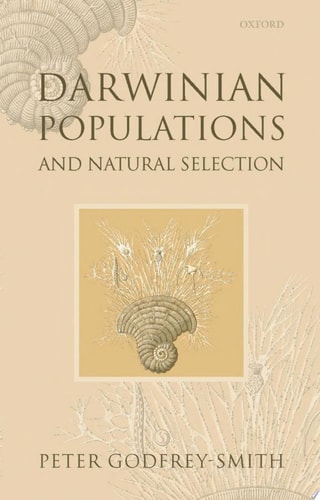
Darwinian Populations and Natural Selection
0
0
As an Amazon Associate and affiliate partner, Menrva Books earns from qualifying purchases. Learn more
Author Description
In 1859 Darwin described a deceptively simple mechanism that he called "natural selection," a combination of variation, inheritance, and reproductive success. He argued that this mechanism was the key to explaining the most puzzling features of the natural world, and science and philosophy were changed forever as a result. The exact nature of the Darwinian process has been controversial ever since, however. Godfrey-Smith draws on new developments in biology, philosophy of science, and other fields to give a new analysis and extension of Darwin's idea. The central concept used is that of a "Darwinian population," a collection of things with the capacity to undergo change by natural selection. From this starting point, new analyses of the role of genes in evolution, the application of Darwinian ideas to cultural change, and "evolutionary transitions" that produce complex organisms and societies are developed. Darwinian Populations and Natural Selection will be essential reading for anyone interested in evolutionary theory.
Menrva's Summary
THE THESIS
This book investigates the fundamental nature of the Darwinian process by defining the conditions under which natural selection occurs. Peter Godfrey-Smith, a prominent philosopher of science, utilizes contemporary biological research and philosophical analysis to refine Darwin's original mechanism. He introduces the concept of a 'Darwinian population' as a rigorous framework to evaluate how variation, inheritance, and reproductive success drive evolutionary change across biological and cultural domains.
THE SCOPE MAP
What You Will Find
- A formal definition of Darwinian populations based on capacity for evolutionary change
- Analysis of the role of genes versus other units of selection
- Examination of evolutionary transitions that lead to complex organisms and societies
- Application of evolutionary theory to cultural change and non-biological systems
THE AUTHORITY PERSPECTIVE
Experts recognize this work as a significant contribution to the philosophy of biology, often citing its clarity in addressing complex theoretical problems. Readers frequently note the academic density of the prose, which serves as a foundational text for those seeking a deeper understanding of evolutionary mechanisms.
Page Count:
224
Publication Date:
2009-05-17
Publisher:
Oxford University Press
ISBN-10:
0199552045
ISBN-13:
9780199552047
Philosophy
Science
Evolutionary Biology
Biology
Natural selection
Evolution
Community Tags
Other Editions(2)
Similar Books