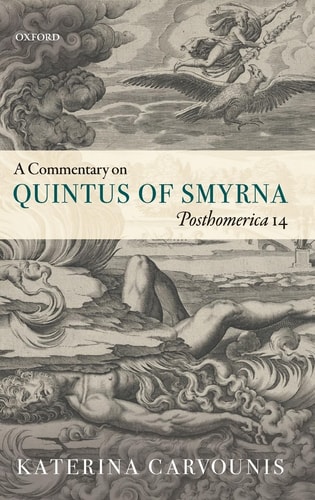
A Commentary on Quintus of Smyrna, Posthomerica 14
0
0
As an Amazon Associate and affiliate partner, Menrva Books earns from qualifying purchases. Learn more
Author Description
The Posthomerica, a Greek epic by Quintus of Smyrna believed to have been written in the third century AD, tells the story of the Trojan War beginning with the events immediately following the sack of Troy and the narrative of the Iliad. Valued as the earliest surviving account of this period, Book 14, the final book of the poem, covers much of the same ground as the lost Iliupersis (The Sack of Troy) attributed to Arctinus of Miletus, from Helen's return to Menelaus and the sacrifice of Polyxena, to the homeward journey of the victorious Greeks, which is abruptly interrupted by a divine storm.This detailed commentary divides the text of Posthomerica 14 into smaller narrative units, introducing each with an overview of the relevant literary tradition and a discussion of Quintus' possible direct models. There follows an exhaustive line-by-line commentary addressing points of literary, stylistic, lexicographic, and textual-critical interest, and providing readers with a range of notes on background and vocabulary. The aim throughout is not only to illuminate the main features of Quintus' poetry, but also to offer as full an interpretation as possible of Posthomerica 14 within both its contemporary literary context and also in dialogue with the earlier tradition, in particular the diction, motifs, and narrative and literary techniques of the Homeric poems and the earlier epic tradition more generally. For readers new to the Posthomerica, the volume also includes a thorough, and up-to-date introduction offering an accessible overview of the poems content, dates, context, models, and possible sources, including both the Epic Cycle and Latin literature.
Menrva's Summary
THE THESIS
This volume investigates the literary, stylistic, and historical significance of Book 14 of Quintus of Smyrna's Posthomerica, the final installment of his epic account of the Trojan War. Katerina Carvounis, a scholar of classical literature, provides a rigorous examination of the text by situating it within the broader tradition of the Epic Cycle and its relationship to Homeric models. The work argues that Book 14 serves as a critical bridge between the lost Iliupersis and the established epic canon, utilizing a line-by-line analytical framework to decode the poet's linguistic and narrative choices.
THE SCOPE MAP
What You Will Find
- A comprehensive line-by-line commentary on the Greek text of Posthomerica 14.
- An analysis of the poem's dialogue with the Homeric tradition and the Epic Cycle.
- A detailed introduction covering the historical context, dating, and literary models of the work.
- Lexicographic and stylistic notes addressing the specific vocabulary and poetic techniques employed by Quintus.
THE AUTHORITY PERSPECTIVE
Scholars and students of classical epic poetry view this commentary as a vital resource for understanding the later Greek epic tradition. Readers frequently note the academic density of the prose, which provides a thorough and necessary interpretation for those engaging with the complexities of the Posthomerica.
Page Count:
400
Publication Date:
2019-10-29
Publisher:
Oxford University Press
ISBN-10:
0199565058
ISBN-13:
9780199565054
History
Literary Criticism
Ancient Greek
Epic Poetry
Greek poetry
Community Tags
Similar Books