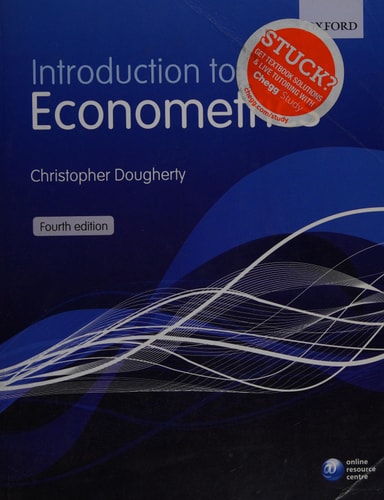
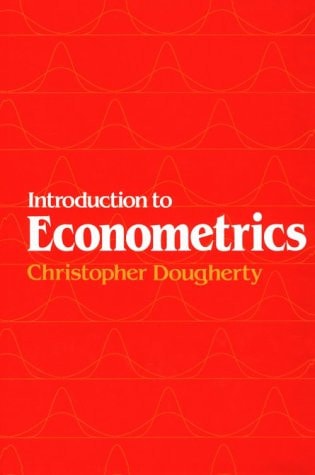
Introduction to Econometrics
0
0
As an Amazon Associate and affiliate partner, Menrva Books earns from qualifying purchases. Learn more
Author Description
Retaining the student-friendly approach of previous editions, Introduction to Econometrics, Fourth Edition, uses clear and simple mathematics notation and step-by step explanations of mathematical proofs to help students thoroughly grasp the subject. Extensive practical exercises throughout--including fifty exercises on the same dataset--build students' confidence and provide them with hands-on practice in applying techniques.NEW TO THE FOURTH EDITION:* An expanded review section at the beginning of the book offers a more comprehensive guide to all of the statistical concepts needed to study econometrics* Additional exercises provide students with even more opportunities to put theory into practice* More Monte Carlo simulations help students use visualization to understand the math* New final sections at the end of each chapter contain summaries and non-technical introductions to more advanced topicsAn updated and expanded Companion Website contains resources for students and instructors:For students:* Data sets* Gretl, a free econometrics software application* PowerPoint-based slides with explanations* A study guideFor instructors:* Instructor manuals for the text and data sets that detail the exercises and their solutions* PowerPoint-based slides* A "Contact the Author" link
Menrva's Summary
THE THESIS
This text investigates the fundamental principles of econometrics by bridging the gap between theoretical statistical concepts and their practical application in economic research. Christopher Dougherty, an experienced educator, utilizes a pedagogical framework that prioritizes clear mathematical notation and step-by-step proofs. By integrating extensive practical exercises with accessible explanations, the author aims to demystify complex quantitative methods for students at the undergraduate level.
THE SCOPE MAP
What You Will Find
- Comprehensive review of foundational statistical concepts required for econometric analysis
- Step-by-step mathematical proofs and derivations for core models
- Practical application exercises utilizing consistent datasets for longitudinal skill building
- Integration of Monte Carlo simulations to visualize abstract mathematical relationships
THE AUTHORITY PERSPECTIVE
Instructors and students frequently identify this text as a highly accessible entry point into the field due to its emphasis on clarity and incremental learning. The academic community values the inclusion of practical software integration and robust exercise sets as foundational tools for developing quantitative proficiency.
Page Count:
573
Publication Date:
2011-04-30
Publisher:
Oxford University Press
ISBN-10:
0199567085
ISBN-13:
9780199567089
Economics
textbook
Mathematics
Econometrics
Statistics
Community Tags
Other Editions(6)

Similar Books


Reader Comments
Share Your Thoughts
No comments yet. Be the first to share your thoughts!