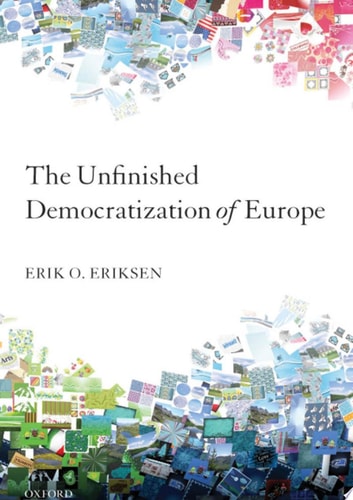
The Unfinished Democratization of Europe
0
0
As an Amazon Associate and affiliate partner, Menrva Books earns from qualifying purchases. Learn more
Author Description
The widening and deepening of the European Union have brought to the fore the question of democracy at the European level. The system of domination already in place at the European level requires and aspires to direct legitimation--from the citizens themselves and not merely indirect, derived from the Member Nation States. Such can only be achieved by making the EU into a democratic polity.But can democracy be disassociated from its putative nation-state foundation? A revised concept of democratic legitimacy based on discourse theory is developed. It is argued that post-national democracy requires a constitution but not necessarily a state.The Union amounts to less than a state but more than an international organization and a system of transnational governance. In the political theory of the multilevel constellation that makes up the EU, it is conceived of as a regional subset of an emerging cosmopolitan order. The EU is a state-less government. As it is not premised on group identity, it is able to accommodate a high measure of variance with regard to territory and function.The book analyzes the reforms undertaken to bring the EU 'closer to the citizens'. It documents elements of democratization and reduction of arbitrary power. However, democracy requires that the citizens can approve or reject the laws they are subjected to. Since the institutional as well as the civic conditions under which a public justification process would be deemed legitimate are not in place, European post-national democracy remains an unaccomplished mission.
Menrva's Summary
THE THESIS
This book investigates whether the European Union can achieve democratic legitimacy without relying on the traditional nation-state foundation. Erik O. Eriksen, a scholar of political theory, utilizes discourse theory to evaluate the EU's current institutional framework. He argues that while the EU functions as a unique, state-less system of transnational governance, it currently lacks the necessary civic conditions for direct citizen legitimation. The work posits that a post-national democracy is theoretically possible but remains an unaccomplished mission in the current political climate.
THE SCOPE MAP
What You Will Find
- An analysis of the EU as a multilevel constellation and a regional subset of a cosmopolitan order.
- A theoretical framework for democratic legitimacy based on discourse theory.
- Documentation of institutional reforms aimed at reducing arbitrary power and increasing citizen proximity.
- An evaluation of the tension between transnational governance and the requirement for public justification of laws.
THE AUTHORITY PERSPECTIVE
Scholars in the field of European studies frequently cite this work as a rigorous contribution to the debate on post-national democratic theory. Readers often note the academic density of the prose, which is intended for advanced students and researchers of political science.
Page Count:
280
Publication Date:
2009-11-23
Publisher:
Oxford University Press
ISBN-10:
0199572518
ISBN-13:
9780199572519
European Union
Governance
Democracy
Political Theory
International relations
Community Tags
Other Editions(2)

Similar Books