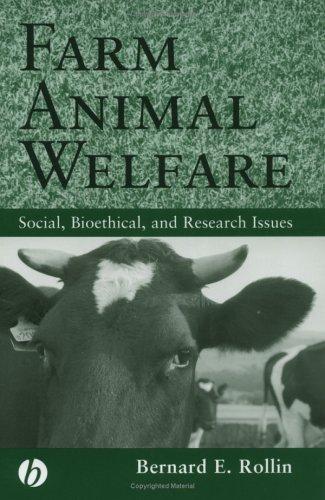
Farm Animal Welfare
0
0
As an Amazon Associate and affiliate partner, Menrva Books earns from qualifying purchases. Learn more
Author Description
Animals born with bones and muscles are meant to move. In modern systems of intensive agriculture, however, many animals - notably, swine, veal calves, and poultry - are rigorously confined. In this book Professor Bernard E. Rollin describes problems of animal welfare in today's agriculture, discusses the research that exists for improving these systems, and proposes topics for further study. Rollin urges animal producers and agricultural scientists to begin now to address welfare problems. He cites the biomedical research community, which ignored issues of pain control and animal welfare until public concern led to federal legislation. Promising work has already been done in Europe, where the public has demanded that livestock not suffer. A new social ethic in the United States calls for humane agricultural systems that meet the needs and natures of the animals we use.
Menrva's Summary
THE THESIS
This book investigates the ethical and practical challenges of animal welfare within modern intensive agricultural systems. Professor Bernard E. Rollin examines the confinement of animals such as swine, veal calves, and poultry, contrasting their natural needs with current farming practices. He reviews existing research aimed at improving these systems and identifies areas requiring further study, drawing parallels with the biomedical community's past neglect of pain control until public pressure mandated change. The work advocates for the development of humane agricultural systems in the United States that acknowledge the inherent needs and natures of farm animals, influenced by growing public demand for ethical treatment seen in Europe.
THE SCOPE MAP
- Analysis of animal welfare issues in intensive agriculture, focusing on confined livestock.
- Discussion of existing research and proposals for improving animal welfare standards.
- Examination of the ethical considerations and the development of a new social ethic for humane agriculture.
- Comparison of animal welfare approaches in the United States and Europe.
- Identification of areas for future research in animal welfare and agricultural science.
- Critique of current farming practices that restrict natural animal movement and behavior.
THE AUTHORITY PERSPECTIVE
The book addresses critical issues in animal welfare within modern agriculture, highlighting the disconnect between animal needs and intensive farming practices. It calls for a proactive approach from producers and scientists to implement more humane systems, drawing on European precedents where public concern has driven legislative change. The work is positioned as a foundational text for understanding the ethical and scientific dimensions of livestock welfare.
Page Count:
168
Publication Date:
1995-01-01
ISBN-10:
0813825636
Science
Animals
Non-Fiction
Animal Science
Ethics
Animal Welfare
Agriculture
Community Tags
Similar Books