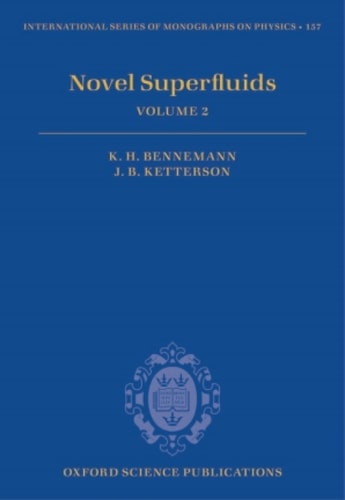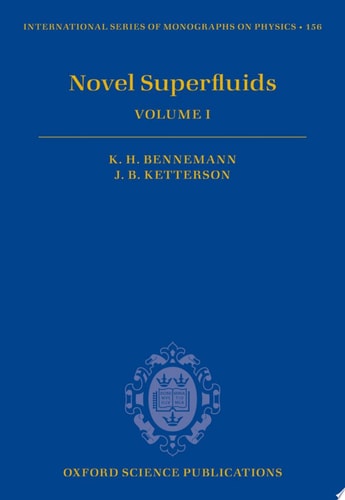
Novel Superfluids: Volume 1
0
0
As an Amazon Associate and affiliate partner, Menrva Books earns from qualifying purchases. Learn more
Author Description
This book reports on the latest developments in the field of Superfluidity. The phenomenon has had a tremendous impact on the fundamental sciences as well as a host of technologies. It began with the discovery of superconductivity in mercury in 1911, which was ultimately described theoretically by the theory of Bardeen Cooper and Schriever (BCS) in 1957. The analogous phenomena, superfluidity, was discovered in helium in 1938 and tentatively explained shortly thereafter as arising from a Bose-Einstein Condensation (BEC) by London. But the importance of superfluidity, and the range of systems in which it occurs, has grown enormously. In addition to metals and the helium liquids the phenomena has now been observed for photons in cavities, excitons in semiconductors, magnons in certain materials, and cold gasses trapped in high vacuum. It very likely exist for neutrons in a neutron star and, possibly, in a conjectured quark state at their center. Even the Universe itself can be regarded as being in a kind of superfluid state. All these topics are discussed by experts in the respective subfields.
Menrva's Summary
THE THESIS
This volume investigates the expansive scope of superfluidity, examining its theoretical foundations and its manifestation across diverse physical systems ranging from laboratory-scale gases to astrophysical phenomena. The authors, John B. Ketterson and Karl-Heinz Bennemann, compile contributions from leading experts to synthesize the historical development of the field, starting from the early discovery of superconductivity to modern observations in photons, excitons, and neutron stars. The text provides a comprehensive framework for understanding how Bose-Einstein Condensation and related mechanisms govern these states of matter.
THE SCOPE MAP
What You Will Find
- Historical analysis of superconductivity and superfluidity discoveries from 1911 to the present.
- Theoretical frameworks including Bardeen Cooper Schriever (BCS) theory and Bose-Einstein Condensation (BEC).
- Examination of superfluid states in photons, excitons, magnons, and cold trapped gases.
- Discussion of astrophysical applications, including neutron star interiors and cosmological models.
THE AUTHORITY PERSPECTIVE
Experts recognize this volume as a comprehensive reference for researchers and graduate students working in condensed matter and low-temperature physics. The text is noted for its academic rigor and its ability to bridge the gap between historical theoretical foundations and contemporary experimental observations.
Page Count:
648
Publication Date:
2013-04-22
Publisher:
Oxford University Press
ISBN-10:
0199585911
ISBN-13:
9780199585915
Science
Condensed Matter Physics
Superfluidity
Physics
Community Tags
Similar Books