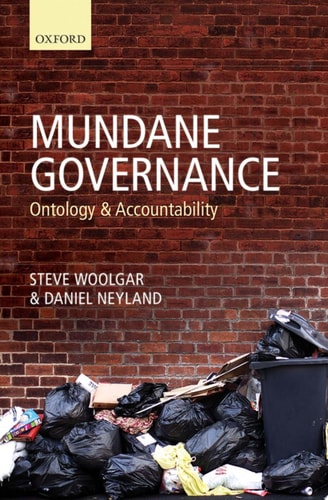
Mundane Governance: Ontology and Accountability
0
0
As an Amazon Associate and affiliate partner, Menrva Books earns from qualifying purchases. Learn more
Author Description
What is to be made of the outcry when newly issued recycling "wheelie" bins are discovered to contain microchips for weighing and evaluating householders' rubbish? The angry accusations that speed cameras are generating excessive income for the government? The consternation at the measures taken by airports to heighten security in the wake of the increased threat of terrorist attacks? These increasingly widespread reactions to ordinary events and everyday phenomena share a common theme. They all embody concerns about the ways in which our lives are increasingly regulated and controlled in relation to ordinary objects and technologies.This book takes these concerns as the starting point for exploring the ways in which relations of governance and accountability in contemporary life are organized around ordinary, everyday, pervasive objects and technologies. In contrast to the contemporary literature on governance, the book argues for the importance of examining how accountability relations are enacted on the ground, in relation to mundane objects and technologies. In particular, it is crucial to understand how governance and accountability are mediated through material relations involving ordinary everyday objects and technologies.The book argues that the key to understanding governance is to focus on political constitution at the level of ontology rather than just on the traditional politics of organization, structure, and human compliance. The term ontology is used here to draw attention to the social and cultural processes whereby the nature and existence of ordinary things come to matter. The argument is developed in relation to a wide variety of empirical materials drawn from three main areas of everyday life: waste management and recycling; the regulation and control of traffic (especially speed cameras and parking); and security and passenger movement in airports.
Menrva's Summary
THE THESIS
This book investigates how contemporary governance and accountability are enacted through the material presence of mundane, everyday objects and technologies. Authors Daniel Neyland and Steve Woolgar, both established scholars in science and technology studies, challenge traditional political analysis by shifting the focus from organizational structures to the ontological status of common items. They argue that the nature and existence of objects like recycling bins, speed cameras, and airport security scanners are central to how social control is negotiated and experienced in daily life.
THE SCOPE MAP
What You Will Find
- Analysis of waste management and recycling infrastructure as sites of regulatory oversight.
- Examination of traffic control technologies, specifically speed cameras and parking enforcement.
- Investigation of security protocols and passenger movement within airport environments.
- A theoretical framework emphasizing the political constitution of objects through social and cultural processes.
THE AUTHORITY PERSPECTIVE
Experts in sociology and science and technology studies identify this work as a significant contribution to the study of material culture and governance. Readers frequently note the academic density of the prose, which is intended for researchers and students interested in the intersection of technology and public policy.
Page Count:
328
Publication Date:
2014-01-21
Publisher:
Oxford University Press
ISBN-10:
0199584745
ISBN-13:
9780199584741
Technology
Ontology
Governance
Public Policy
Sociology
Community Tags
Similar Books