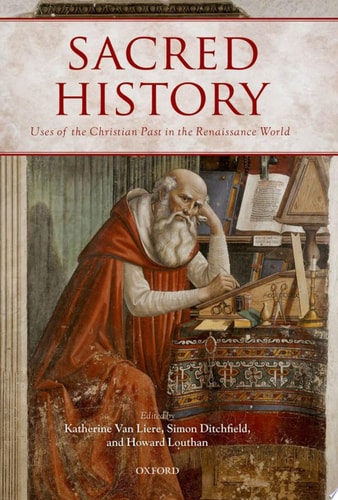
Sacred History: Uses of the Christian Past in the Renaissance World
0
0
As an Amazon Associate and affiliate partner, Menrva Books earns from qualifying purchases. Learn more
Author Description
This volume provides the first geographically broad, comparative survey of early modern 'sacred history', or writing on the history of the Christian Church, its leaders and saints, and its institutional and doctrinal developments, in the two centuries from c. 1450-1650. With deep medieval roots, ecclesiastical history was generally a conservative enterprise, often serving to reinforce confessional, national, regional, dynastic, or local identities. But writers of sacred history innovated in research methods and in techniques of scholarly production, especially after the advent of print. The demand for sacred history was particularly acute in the various movements for religious reform, in both Catholic and Protestant traditions. After the Renaissance, many writers sought to apply humanist critical principles to writing about the church, but the sceptical thrust of humanist historiography threatened to undermine many ecclesiastical traditions, and religious historians often had to wrestle with tensions between criticism and piety.Thirteen thematic chapters examine the influence of Renaissance humanism, religious reform, and other political, intellectual, and social developments of these two centuries on the writing of ecclesiastical history in its various forms. These diverse genres, inherited from medieval culture, included saints' lives, diocesan histories, national chronicles, and travel accounts. Early chapters examine Catholic and Protestant traditions of sacred historiography in western Europe, especially Italy and Switzerland. Subsequent chapters examine particular instances of sacred historiography in Germany, central Europe, Spain, England, Ireland, France, and Portuguese India; and developments in Christian art historiography and Holy Land antiquarianism.
Menrva's Summary
THE THESIS
This volume investigates how the writing of ecclesiastical history evolved during the Renaissance and Reformation, specifically examining the tension between humanist critical methods and traditional religious piety. The authors, Howard Louthan, Katherine Van Liere, and Simon Ditchfield, curate a collection of essays that analyze how early modern scholars documented the Christian past to serve confessional, national, and institutional agendas. By synthesizing research across diverse European regions, the text argues that the development of sacred history was a complex negotiation between the preservation of inherited medieval traditions and the adoption of new, print-driven scholarly techniques.
THE SCOPE MAP
What You Will Find
- A comparative survey of sacred historiography across Europe, including Italy, Switzerland, Germany, Spain, England, Ireland, France, and Portuguese India.
- Analysis of diverse literary genres such as saints' lives, diocesan histories, national chronicles, and travel accounts.
- Examination of the impact of Renaissance humanism and the printing press on historical research methods.
- Discussion of the intersection between religious reform movements and the construction of institutional identity.
THE AUTHORITY PERSPECTIVE
Scholars and historians recognize this work as a foundational comparative study of early modern ecclesiastical historiography. Readers frequently note the academic density of the prose and the breadth of the geographical coverage provided by the contributors.
Page Count:
364
Publication Date:
2012-07-13
Publisher:
Oxford University Press
ISBN-10:
0199594791
ISBN-13:
9780199594795
History
Religion
Church History
Renaissance
European History
Historiography
Community Tags
Similar Books