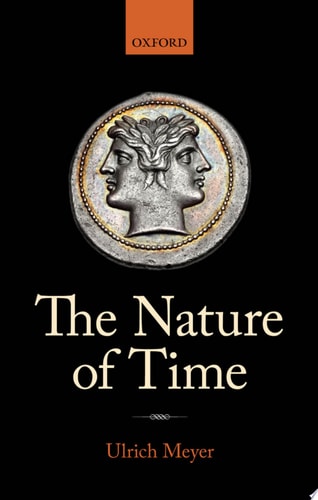
The Nature of Time
0
0
As an Amazon Associate and affiliate partner, Menrva Books earns from qualifying purchases. Learn more
Author Description
The theory of relativity convinced many philosophers that space and time are fundamentally alike, and that they are mere aspects of a more fundamental space-time. In The Nature of Time, Ulrich Meyer argues against this consensus view. Instead of a "spatial" account of time that treats instants like positions in space, he presents the first comprehensive defense of a 'modal' account that emphasizes the similarities between times and the possible worlds in modal logic. Modal accounts of time are naturally cast in terms of a tense logic that accounts for temporal distinctions in terms of primitive tense operators. Tense logic was originally developed to provide a linguistic theory of verb tense in natural languages, but here Meyer proposes that it can be treated as a metaphysical theory of the nature of time. Contrary to popular belief, such modal accounts of time do not commit us to the view that there is something metaphysically special about the present moment, and they are easily reconciled with the theory of relativity.
Menrva's Summary
THE THESIS
Ulrich Meyer investigates whether time should be understood through a spatial framework or a modal framework, challenging the prevailing consensus that time is merely a dimension of space-time. Meyer, a philosopher specializing in metaphysics and the philosophy of time, utilizes the formal structures of modal logic to construct his argument. He posits that tense logic, traditionally used for linguistic analysis, serves as a robust metaphysical foundation for understanding temporal reality. By doing so, he seeks to reconcile the distinct nature of time with the established principles of the theory of relativity.
THE SCOPE MAP
What You Will Find
- A comparative analysis between spatial and modal accounts of time
- The application of tense logic as a metaphysical tool
- A reconciliation of modal temporal theory with relativistic physics
- Arguments addressing the metaphysical status of the present moment
THE AUTHORITY PERSPECTIVE
Scholars in the field of analytic philosophy recognize this work as a significant contribution to the ongoing debate regarding the ontology of time. Readers frequently note the technical density of the prose, which requires a foundational understanding of modal logic and contemporary metaphysics to fully grasp the author's propositions.
Page Count:
192
Publication Date:
2013-09-15
Publisher:
Oxford University Press
ISBN-10:
0199599335
ISBN-13:
9780199599332
Philosophy
Science
Logic
Metaphysics
Physics
Space and time
Community Tags
Other Editions(2)
Similar Books