Exotic Spaces in German Modernism
0
0
As an Amazon Associate and affiliate partner, Menrva Books earns from qualifying purchases. Learn more
Author Description
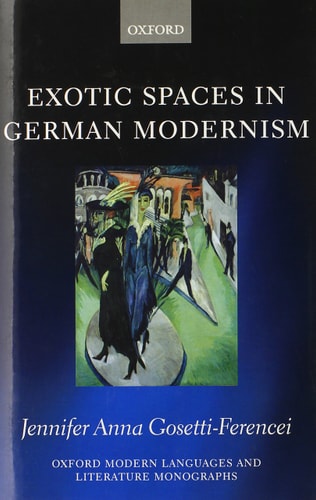
Jennifer Anna Gosetti-Ferencei demonstrates that the exotic, as reflected in major works of German literature and in the philosophy and art that inspires it, provokes central questions about the modern self and the spaces it inhabits. Exotic spaces in the writings of such authors as Thomas Mann, Franz Kafka, Stefan Zweig, Robert Musil, Hugo von Hofmannsthal, Gottfried Benn, and Bertold Brecht, along with the thought of Nietzsche, Freud, Levi-Strauss, and Simmel and the art of German Expressionism, are shown to present alternatives to the landscape and experience of modernity. In an examination of the concept of the exotic and of spatial experience in their cultural, subjective, and philosophical contingencies, Gosetti-Ferencei shows that exotic spaces may contest and reconfigure the relationship between the familiar and the foreign, the self and the other. Exotic spaces may serve not only to affirm the subject in a symbolic conquering of territory, as emphasized in post-colonial interpretations, or project the fantasy of escapism to a lost paradise, as utopian readings suggest, but condition moral, aesthetic, or imaginative transformation. Such transformation, while risking disaster or dissolution of the self as well as endangerment of the other, may promote new possibilities of perceiving or being, and reconfigure the boundaries of a familiar world. As exotic spaces are conceived as mystical, liberating, erotic, infectious, frightening or mysterious, several possibilities for transformation emerge in their exposure: re-enchantment through epiphany; the collapse of the rational self; liberation of the imagination from the confines of the familiar world; and aesthetic transformation, revealing the paradoxically 'primitive' nature of modern experience. In strikingly original readings of canonical authors and compelling rediscoveries of forgotten ones, this study establishes that exotic experience can evidence the fragility of the European or Germanic self as depicted in modernist literature, revealing the usually unconsidered boundaries of the subject's own familiar world.
Menrva's Summary
THE THESIS
This work investigates how the concept of the 'exotic' functions as a critical site for reconfiguring the modern self within German literature and philosophy. Jennifer Anna Gosetti-Ferencei, a scholar of modern languages, utilizes a multidisciplinary approach that synthesizes literary analysis, philosophical inquiry, and art history. She argues that exotic spaces in modernist texts serve as more than mere escapism or colonial projection, acting instead as catalysts for moral, aesthetic, and imaginative transformation that challenge the boundaries of the rational subject.
THE SCOPE MAP
What You Will Find
- Analysis of canonical German authors including Thomas Mann, Franz Kafka, Stefan Zweig, and Robert Musil.
- Integration of philosophical perspectives from Nietzsche, Freud, and Simmel.
- Examination of German Expressionist art as a visual counterpart to literary spatiality.
- Theoretical frameworks concerning the relationship between the familiar and the foreign, and the subjective experience of space.
THE AUTHORITY PERSPECTIVE
Scholars recognize this monograph as a rigorous contribution to the study of German Modernism, particularly for its nuanced handling of spatial theory and subjectivity. The text is noted for its dense, academic prose that demands a high level of familiarity with both the primary literary sources and the philosophical traditions discussed.
Page Count:
288
Publication Date:
2011-11-15
Publisher:
Oxford University Press
ISBN-10:
0199604126
ISBN-13:
9780199604128
Philosophy
German
Modernism
Literary Criticism
Community Tags
Similar Books