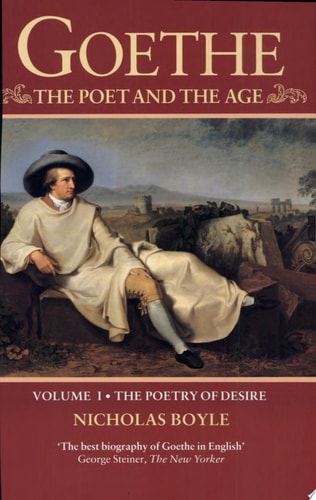
Goethe: The Poet and the Age: Volume I: The Poetry of Desire (1749-1790)
0
0
As an Amazon Associate and affiliate partner, Menrva Books earns from qualifying purchases. Learn more
Author Description
In 1880 Nietzsche observed that Goethe had been "not just a good and great man, but an entire culture." The author of Faust, of exquisite lyric poetry, and of a bewildering variety of other plays, novels, and poetry as well as treatises on botany and color theory, Goethe also excelled as an administrator in the cabinet of Carl August, Duke of Saxe-Weimar. Now, Nicholas Boyle has written the definitive biography of this extraordinary figure--indeed, The Poet and the Age is the first full-length, original English-language biography of Goethe in sixty years.In this elegant and enjoyable first volume--the first of two projected books--Boyle captures the passions and poetry of the young Goethe, leading us up to the moment when the French Revolution shook the foundations of all of Europe. Boyle contends that, although Goethe was certainly as much a part of German social and political life as he was its cultural nucleus, there was no single "Age of Goethe." Instead, Goethe's life spanned a great divide in European history: half was spent under a monarchy, and half under a middle-class bureaucracy. The first forty years of Goethe's creative life, rendered by Boyle in captivating detail, saw the early conception of Faust, and Goethe's rise to literary fame on the heels of his bestselling sentimental novel The Sorrows of Young Werther, a book which captured the European imagination like no other before it. Werther became a fashion in a strikingly contemporary sense: impassioned readers imitated the clothing, the sentiments, and even the tragic suicide of the novel's young hero. Napoleon claimed to have read Goethe's book seven times, and years later Mary Shelley cited it as the first book read by the monster she created in Frankenstein. Boyle provides not only close and provocative readings of Goethe's literary works, but also a vivid portrayal of a convulsive age of revolution, including insights into Weimar court life, and accounts of other master thinkers like Lessing and
Menrva's Summary
THE THESIS
This volume investigates how Johann Wolfgang von Goethe functioned as both a central cultural figure and a product of the shifting socio-political landscape of late 18th-century Europe. Nicholas Boyle, a scholar of German literature, utilizes extensive archival research and historical context to argue that Goethe’s life was defined by the transition from monarchical structures to a burgeoning middle-class bureaucracy. The text examines the intersection of Goethe’s personal development, his administrative career in Weimar, and his literary output during the period leading up to the French Revolution.
THE SCOPE MAP
What You Will Find
- A detailed biographical account of Goethe from 1749 to 1790.
- Analysis of the cultural and political climate of the Weimar court.
- Critical readings of major works including The Sorrows of Young Werther and early drafts of Faust.
- Contextualization of Goethe’s influence on contemporary European thought and literature.
Scope Limits
- This volume concludes in 1790 and does not cover the later years of Goethe’s life or his reactions to the Napoleonic era.
- The text focuses primarily on the German cultural context, with limited exploration of non-European global influences.
THE AUTHORITY PERSPECTIVE
Scholars and critics frequently cite this work as a foundational, comprehensive biography that successfully bridges the gap between literary analysis and historical narrative. Readers often note the academic density of the prose, which provides a rigorous examination of the intellectual currents defining the era.
Page Count:
848
Publication Date:
1992-12-03
Publisher:
Oxford University Press
ISBN-10:
0192829815
ISBN-13:
9780192829818
Biography
German
18th century
Literary Criticism
European History
Community Tags
Other Editions(2)
Similar Books











Reader Comments
Share Your Thoughts
No comments yet. Be the first to share your thoughts!