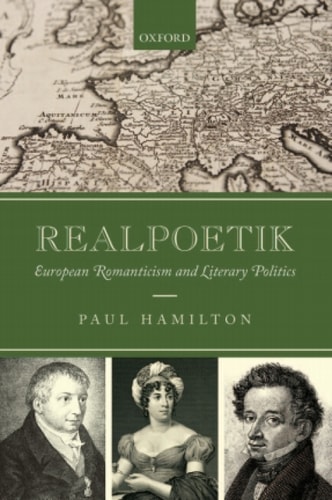
Realpoetik: European Romanticism and Literary Politics
0
0
As an Amazon Associate and affiliate partner, Menrva Books earns from qualifying purchases. Learn more
Author Description
Realpoetik compares the writings of key German, French, and Italian Romantics, with an eye to their differences from British Romanticism. The principle of selection is to choose writers whose use of fiction is realistic -- not realist, but fundamentally contributory to the purposes of non-fictional discourse. The political resonance audible when we put Real at the start of a compound noun is also true to the period looked at. At that time, positive political institutions were recovering from their upending in the French Revolution and their strategic re-shaping in the period of Restoration after Napoleon. In this volume, Paul Hamilton pinpoints a moment when the political imagination was actually creative of political reality. It is a long gloss on Friedrich Meinecke's description of the early Romantic period in Germany as 'that past era of teeming intellectual impulses with its excess of non-political political ideals', but Hamilton finds his insight into the contemporary inextricability of the ideal and the political true of France and Italy. Before the existence of a unified Germany or Italy, and in the new France after Napoleon, there was an opportunity and a necessity to imagine the kind of nation which would be desirable. Realpoetik examines the extent to which this illuminates the fiction and philosophy of Friedrich Schlegel, Madame de Staël, Giacomo Leopardi and others. It also reflects on current dissatisfaction with existing political arrangements and our contemporary desire to re-imagine a new, more representative politics.
Menrva's Summary
THE THESIS
This work investigates the intersection of Romantic literature and political formation, questioning how early 19th-century writers utilized fiction to construct new political realities. Paul Hamilton, a scholar of Romanticism, draws upon the historical context of post-Napoleonic Europe to analyze how German, French, and Italian intellectuals navigated the vacuum left by the French Revolution. He argues that these writers did not merely reflect their environment but actively shaped the political imagination of their respective nations through their philosophical and literary output.
THE SCOPE MAP
What You Will Find
- Comparative analysis of German, French, and Italian Romanticism
- Examination of Friedrich Schlegel, Madame de Staël, and Giacomo Leopardi
- Theoretical framework linking 'Realpoetik' to the creation of political institutions
- Historical context of the Restoration period following the Napoleonic Wars
Scope Limits
- Does not provide a comprehensive survey of British Romanticism
- Does not offer a practical guide for modern political reform
THE AUTHORITY PERSPECTIVE
Scholars recognize this text as a sophisticated contribution to the study of Romanticism and its political implications. Readers frequently note the academic density of the prose, which requires a strong background in European intellectual history to fully appreciate the author's arguments.
Page Count:
256
Publication Date:
2013-01-01
Publisher:
OUP Oxford
ISBN-10:
019150971X
ISBN-13:
9780191509711
English & College Success
French literature
Italian
English
European History
German
Literary Criticism
Political Philosophy
Romanticism
Community Tags
Similar Books