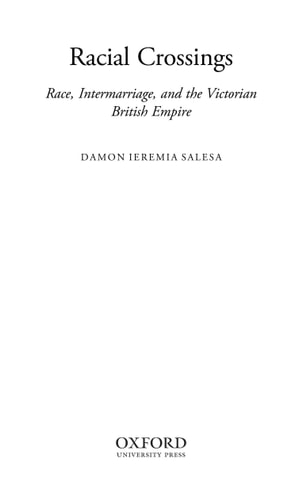
Racial Crossings: Race, Intermarriage, and the Victorian British Empire
0
0
As an Amazon Associate and affiliate partner, Menrva Books earns from qualifying purchases. Learn more
Author Description
The Victorians were fascinated with intersections between different races. Whether in sexual or domestic partnerships, in interracial children, racially diverse communities or societies, these 'racial crossings' were a lasting Victorian concern. But in an era of imperial expansion, when slavery was abolished, colonial wars were fought, and Britain itself was reformed, these concerns were more than academic. In both the British empire and imperial Britain, racial crossings shaped what people thought about race, the future, the past, and the conduct and possibilities of empire. Victorian fears of miscegenation and degeneration are well known; this study turns to apparently opposite ideas where racial crossing was seen as a means of improvement, a way of creating new societies, or a mode for furthering the rule of law and the kingdom of Heaven.Salesa explores how and why the preoccupation with racial crossings came to be so important, so varied, and so widely shared through the writings and experiences of a raft of participants: from Victorian politicians and writers, to philanthropists and scientists, to those at the razor's edge of empire - from soldiers, missionaries, and settlers, to 'natives', 'half-castes' and other colonized people. Anchored in the striking history of colonial New Zealand, where the colonial policy of 'racial amalgamation' sought to incorporate and intermarry settlers and New Zealand Māori, Racial Crossings examines colonial encounters, working closely with indigenous ideas and experiences, to put Victorian racial practice and thought into sharp, critical, relief.
Menrva's Summary
THE THESIS
This study investigates how the Victorian preoccupation with racial intermarriage and mixing functioned as a central mechanism for shaping imperial policy and social identity within the British Empire. Damon Ieremia Salesa, a scholar of Pacific and colonial history, utilizes a vast array of primary sources—ranging from political correspondence to missionary records—to challenge the singular narrative that Victorian racial thought was defined solely by fears of degeneration. He argues that in specific colonial contexts, such as New Zealand, racial crossing was actively promoted as a tool for societal improvement and the expansion of imperial governance.
THE SCOPE MAP
What You Will Find
- Analysis of the colonial policy of racial amalgamation in 19th-century New Zealand.
- Examination of diverse perspectives including settlers, missionaries, and indigenous Māori populations.
- Investigation into the intersection of Victorian scientific, philanthropic, and political discourse on race.
- Evaluation of how domestic and international interracial partnerships influenced the conduct of the British Empire.
THE AUTHORITY PERSPECTIVE
Historians and scholars of colonial studies frequently cite this work for its nuanced approach to the complexities of Victorian racial ideology. Experts highlight the text as a significant contribution to understanding how local colonial encounters informed broader imperial strategies.
Page Count:
320
Publication Date:
2011-07-14
Publisher:
Oxford University Press
ISBN-10:
0199604150
ISBN-13:
9780199604159
History
Great Britain
Race Relations
British Empire
Colonialism
Sociology
Community Tags
Similar Books