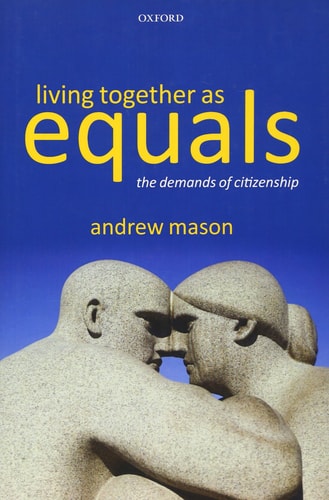
Living Together as Equals: The Demands of Citizenship
0
0
As an Amazon Associate and affiliate partner, Menrva Books earns from qualifying purchases. Learn more
Author Description
Traditional understandings of citizenship are facing a number of challenges. Ideas of cosmopolitan and environmental citizenship have emerged in the light of concerns about global inequality and climate change, whilst new models of multicultural citizenship have been developed in response to the dilemmas posed by immigration and the presence of national minorities. At the same time, more particular debates take place about the demands citizenship places upon us in our everyday lives. Do we have a duty as citizens to take steps to reduce the risk of needing to rely upon state benefits, including health care? Does good citizenship require that we send our children to the local school even when it performs poorly? Does a parent fail in his duty as a citizen - not just as a father, say - when he is less involved in the raising of his children than their mother? Should citizens refrain from appealing to religious reasons in public debate? Do immigrants have a duty to integrate? Do we have duties of citizenship to minimise the size of our ecological footprints? This book develops a normative theory of citizenship that brings together issues such as these under a common framework rather than treating them in isolation in the way that often happens. It distinguishes two different ways of thinking about citizenship both of which shed some light on the demands that is makes upon us: according to the first approach, the demands of citizenship are grounded exclusively in considerations of justice, whereas according to the second, they are grounded in the good that is realised by a political community the members of which treat each other as equals not only in the political process but in civil society and beyond.
Menrva's Summary
THE THESIS
This book investigates the normative demands of citizenship by proposing a unified framework that reconciles individual duties with the requirements of a political community. Andrew Mason, a professor of political theory, utilizes a rigorous analytical approach to evaluate how contemporary challenges—ranging from environmental responsibility to multicultural integration—intersect with the fundamental obligation of citizens to treat one another as equals. By contrasting justice-based models with community-based models, the author constructs a comprehensive theory that addresses both public policy and private conduct.
THE SCOPE MAP
What You Will Find
- Analysis of multicultural citizenship in the context of immigration and national minorities.
- Examination of everyday civic duties, including parental responsibilities and public school participation.
- Evaluation of cosmopolitan and environmental citizenship frameworks.
- A comparative methodology distinguishing between justice-grounded and community-grounded civic obligations.
THE AUTHORITY PERSPECTIVE
Scholars in political philosophy recognize this work as a significant contribution to the normative study of civic duty. Readers frequently note the academic density of the prose, which is best suited for those already familiar with contemporary debates in political theory and ethics.
Page Count:
272
Publication Date:
2012-07-26
Publisher:
Oxford University Press
ISBN-10:
0199606242
ISBN-13:
9780199606245
Philosophy
Citizenship
Ethics
Sociology
Community Tags
Similar Books