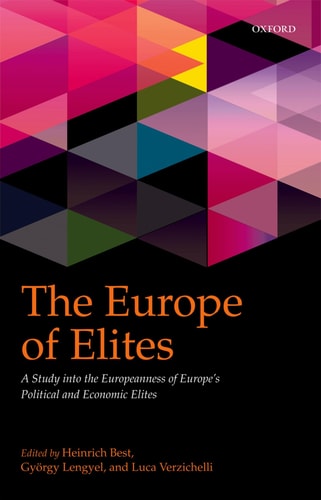
The Europe of Elites: A Study into the Europeanness of Europe's Political and Economic Elites
0
0
As an Amazon Associate and affiliate partner, Menrva Books earns from qualifying purchases. Learn more
Author Description
This is an open access title available under the terms of a CC BY-NC-ND 3.0 International licence. It is free to read at Oxford Scholarship Online and offered as a free PDF download from OUP and selected open access locations.It has been widely acknowledged that the process of European integration and unification was started and is still pursued as an elite project, designed to put an end to debilitating conflicts and rivalries by consolidating a common power base and by pooling Europe's economic resources. Nevertheless elites have remained the known unknowns of the European integration process. The present volume is designed to change this. Based on surveys of political and economic elites in 18 European countries, it is a comprehensive study of the visions, fears, cognitions and values of members of national parliaments and top business leaders underlying their attitudes towards European integration. It also investigates political and economic elites' embeddedness in transnational networks and their ability to communicate in multicultural settings. The book strongly supports the view of an elitist character of the process of European integration on the one hand, while challenging the idea that European national elites have merged or are even merging into a coherent Eurelite on the other. As the 11 chapters of this book show the process of European integration is much more colourful and even contradictory than concepts of a straight forward normative and structural integration suggest. In particular this process is deeply rooted in, and conditional on, the social and political settings in national contexts. The empirical basis for this book is provided by the data of the international IntUne project, which has for the first time created a comprehensive database combining coordinated surveys of Europe-related attitudes at the elite and general population level.
Menrva's Summary
THE THESIS
This volume investigates the extent to which European political and economic elites share a unified vision of integration and whether they are coalescing into a singular, transnational 'Eurelite'. The authors, Gyorgy Lengyel, Heinrich Best, and Luca Verzichelli, utilize extensive survey data from the IntUne project to analyze the values, fears, and attitudes of national parliamentarians and business leaders across 18 European countries. By examining these elites' embeddedness in transnational networks and their multicultural communication capabilities, the study challenges monolithic theories of European integration. The research argues that integration remains a complex, contradictory process deeply tethered to specific national social and political contexts rather than a uniform structural merger.
THE SCOPE MAP
What You Will Find
- Empirical data from the IntUne project covering surveys of political and economic elites in 18 European nations.
- Comparative analysis of elite attitudes toward European integration, including their visions, fears, and core values.
- Examination of transnational network participation and multicultural communication skills among top-tier decision-makers.
- A critical assessment of the 'Eurelite' hypothesis, contrasting it with evidence of persistent national-level divergence.
THE AUTHORITY PERSPECTIVE
Experts recognize this work as a foundational empirical study for understanding the social and political dimensions of European integration. Readers frequently note the academic density of the prose and the rigorous methodological approach to elite survey data.
Page Count:
312
Publication Date:
2012-05-23
Publisher:
Oxford University Press
ISBN-10:
019960231X
ISBN-13:
9780199602315
Economics
International relations
Sociology
Europe
Community Tags
Similar Books









Reader Comments
Share Your Thoughts
No comments yet. Be the first to share your thoughts!