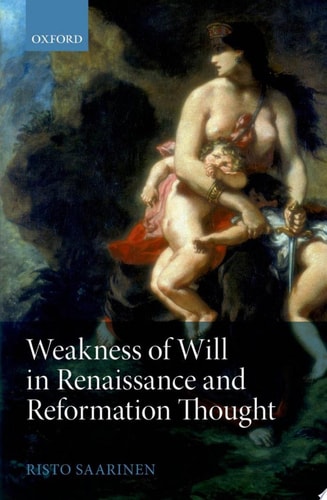
Weakness of Will in Renaissance and Reformation Thought
0
0
As an Amazon Associate and affiliate partner, Menrva Books earns from qualifying purchases. Learn more
Author Description
Weakness of will, the phenomenon of acting contrary to one's own better judgment, has remained a prominent discussion topic of philosophy. The history of this discussion in ancient, medieval, and modern times has been outlined in many studies. Weakness of Will in Renaissance and Reformation Thought is, however, the first book to cover the fascinating source materials on weakness of will between 1350 and 1650. In addition to considering the work of a broad range of Renaissance authors (including Petrarch, Donato Acciaiuoli, John Mair, and Francesco Piccolomini), Risto Saarinen explores the theologically coloured debates of the Reformation period, such as those provided by Martin Luther, Philip Melanchthon, John Calvin, and Lambert Daneau. He goes on to discuss the impact of these authors on prominent figures of early modernity, including Shakespeare, Descartes, Spinoza, and Leibniz.While most of the historical research on weakness of will has focused on the reception history of Aristotle's Nicomachean Ethics, Saarinen pays attention to the Platonic and Stoic discussions and their revival during the Renaissance and the Reformation. He also shows the ways in which Augustine's discussion of the divided will is intertwined with the Christian reception of ancient Greek ethics, and argues that the theological underpinnings of early modern authors do not rule out weakness of will, but transform the philosophical discussion and lead it towards new solutions.
Menrva's Summary
THE THESIS
This book investigates how the concept of weakness of will, or akrasia, evolved and was reinterpreted within the intellectual frameworks of the Renaissance and the Reformation. Risto Saarinen, a scholar of historical theology and philosophy, examines the transition of this concept from its classical roots to its early modern applications. By analyzing a wide array of primary sources from 1350 to 1650, he argues that theological shifts during this period did not eliminate the philosophical problem of the divided will but instead fundamentally transformed how thinkers approached human agency and moral failure.
THE SCOPE MAP
What You Will Find
- A comprehensive analysis of philosophical and theological texts spanning the years 1350 to 1650.
- Comparative studies of Renaissance humanists like Petrarch alongside Reformation theologians such as Luther and Calvin.
- Examination of the influence of Platonic, Stoic, and Aristotelian ethics on early modern thought.
- Exploration of the intersection between Augustinian theology and Greek ethical traditions regarding the human will.
THE AUTHORITY PERSPECTIVE
Scholars recognize this work as a significant contribution to the history of philosophy, particularly for its focus on the often-overlooked period between the medieval and early modern eras. Readers frequently note the academic density of the prose and the author's meticulous attention to the theological nuances that shaped Western conceptions of moral choice.
Page Count:
256
Publication Date:
2011-09-05
Publisher:
Oxford University Press
ISBN-10:
0199606811
ISBN-13:
9780199606818
Philosophy
History
Theology
Reformation
Renaissance
Ethics
Philosophy & Religion
Community Tags
Other Editions(3)

Similar Books