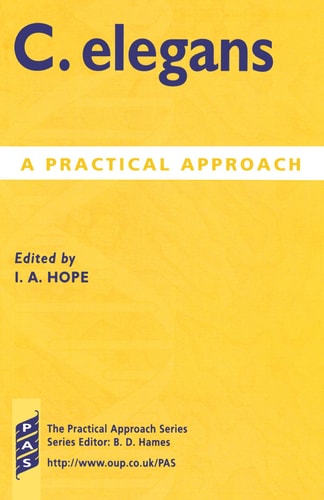
C. elegans: A Practical Approach
0
0
As an Amazon Associate and affiliate partner, Menrva Books earns from qualifying purchases. Learn more
Author Description
Caenorhabditis Elegans has been a popular model organism for biological research for over thirty years and has been used to investigate many aspects of animal development, for example apoptosis, the Hox genes, signal transduction pathways, and the development of the nervous system. It has recently taken on new importance with the publication of the entire genome sequence in 1998. The first chapter gives all the basic information on C. elegans required to use it: it's natural history, anatomy, life cycle, development, and evolution. Information on how to obtain, grow, and maintain C. elegans for use as a model system is given in Chapter 4. Chapters 2 and 3 describe the genome project and show how to use genome sequence information by searching the database for homologues using different search methods and then how to analyse the search data. The next chapter gives the essential practical details of transformation and common uses for the technique. Chapter 6 covers reverse genetics and describes strategies for gene inactivation that are known to work in C elegans: epigenetic inactivation and mutational germ line inactivation. Chapter 7 is designed to help the user analyse phenotype by microscopy and includes Normaski, fluorescence, 4-dimensional, and electron microscopy. Techniques for studying the neurobiology of C. elegans are given in chapter 8. Chapter 9 describes the three commonly used approaches for studying gene expression and Chapter 10 deals with the common methods of molecular biology essential for gene characterization. C. elegans is not the ideal organism for biochemical studies, but chapter 11 describes several procedures for producing biochemically useful quantities of pure tissues. The final chapter is about conventional genetics and details the standard procedures for selfing and crossing; mutagenesis and mutant screening; characterization of mutants; gene mapping; temperature-shift experiments and mosaic analysis. Caenorhabditis Elegans: A Practical Approach will therefore provide all the background information necessary for use of C. elegans as a model system.
Menrva's Summary
THE THESIS
This book investigates the practical methodologies required to utilize the nematode Caenorhabditis elegans as a primary model organism in biological research. Ian A. Hope provides a comprehensive technical framework for researchers, synthesizing the organism's biological history with specific laboratory protocols. The text serves as a manual for navigating the genome, performing genetic manipulation, and conducting phenotypic analysis within a controlled laboratory environment.
THE SCOPE MAP
What You Will Find
- Detailed protocols for the maintenance, growth, and cultivation of C. elegans cultures.
- Methodologies for genomic database searching and sequence analysis.
- Technical procedures for transformation, gene inactivation, and reverse genetics.
- Specialized microscopy techniques including Nomarski, fluorescence, and 4-dimensional imaging.
- Standardized genetic practices such as mutagenesis, mutant screening, and mosaic analysis.
THE AUTHORITY PERSPECTIVE
Experts recognize this text as a foundational resource for molecular biologists and geneticists working with model organisms. Readers frequently note the high density of technical information, which serves as a reliable reference for both novice and experienced laboratory practitioners.
Page Count:
304
Publication Date:
1999-12-15
Publisher:
Oxford University Press
ISBN-10:
0199637385
ISBN-13:
9780199637386
Science
Laboratory Manual
Biology
Genetics
Zoology
Reference
Community Tags
Other Editions(3)
Similar Books


Reader Comments
Share Your Thoughts
No comments yet. Be the first to share your thoughts!