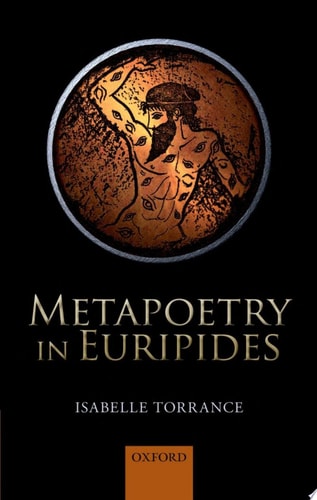
Metapoetry in Euripides
0
0
As an Amazon Associate and affiliate partner, Menrva Books earns from qualifying purchases. Learn more
Author Description
Metapoetry in Euripides is the first detailed study of the self-conscious literary devices applied within Euripidean drama and how these are interwoven with issues of thematic importance, whether social, theological, or political. In the volume, Torrance argues that Euripides employed a complex system of metapoetic strategies in order to draw the audience's attention to the novelty of his compositions. The metapoetic strategies discussed include intertextual allusions to earlier poetic texts (especially to Homer, Aeschylus and Sophocles) which are often developed around unusual and memorable language or imagery, deployment of recognizable trigger words referring to plot construction, novelties or secondary status, and self-conscious references to fiction implied through allusion to writing.Torrance also looks at and compares metapoetic techniques used in tragedy, satyr-drama, and old comedy to demonstrate that the Greek tragedians commonly exploited metapoetic strategies, and that metapoetry is more pervasive in Euripides than in the other tragedians. While Euripides shares some metapoetic techniques with old comedy, these remain implicit in his tragedies (but not in his satyr-dramas).
Menrva's Summary
THE THESIS
This volume investigates the extent to which Euripides utilized self-conscious literary devices to signal the innovation of his dramatic compositions to his contemporary audience. Isabelle Torrance, a scholar of classical literature, examines the intersection of metapoetic strategy with the social, theological, and political themes embedded in Euripidean drama. By analyzing the playwright's deliberate use of intertextual allusion and linguistic markers, the author constructs a framework for understanding how Euripides distinguished his work from that of his predecessors and contemporaries.
THE SCOPE MAP
What You Will Find
- Comparative analysis of metapoetic techniques across tragedy, satyr-drama, and old comedy.
- Examination of intertextual allusions to Homer, Aeschylus, and Sophocles.
- Identification of specific trigger words related to plot construction and narrative novelty.
- Discussion of self-conscious references to the act of writing and the nature of fiction.
THE AUTHORITY PERSPECTIVE
Scholars recognize this work as a foundational study for understanding the structural complexity of Euripidean drama. Readers frequently note the academic density of the prose, which serves as a rigorous resource for those specializing in classical philology and ancient theatrical conventions.
Page Count:
384
Publication Date:
2013-04-05
Publisher:
Oxford University Press
ISBN-10:
0199657831
ISBN-13:
9780199657834
History
Drama
Literary Criticism
Ancient Greek
Community Tags
Other Editions(2)

Similar Books