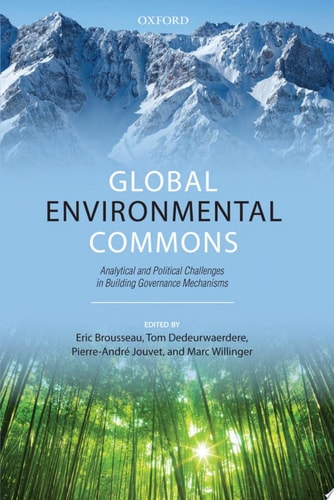
Global Environmental Commons: Analytical and Political Challenges in Building Governance Mechanisms
0
0
As an Amazon Associate and affiliate partner, Menrva Books earns from qualifying purchases. Learn more
Author Description
Environmental challenges, and the potential solutions to address them, have a direct effect on living standards, the organization of economies, major infrastructures, and modes of urbanization. Since the publication of path-breaking contributions on the governance of environmental resources in the early 1990s, many political initiatives have been taken, numerous governance experiments have been conducted, and a large multi-disciplinary field of research has opened up. This interdisciplinary book takes stock of the knowledge that has accumulated to date, and addresses new challenges in the provision of environmental goods. It focuses on three essential dimensions with respect to governance. First, it addresses the issue of designing governance solutions through analyzing systems of rules, and levels of organization, in the governance and management of environmental issues. Second, it draws renewed attention to the negotiation processes among stakeholders playing a crucial role in reaching agreements over issues and solutions, and in choosing and implementing particular policy instruments. Finally, it shows that compliance depends on a combination of formal rules, enforced by recognized authorities, and informal obligations, such as social and individual norms.The evolution of the research frontiers on environmental governance shows that more legitimate and informed processes of collective decision, and more subtle and effective ways of managing compliance, can contribute to more effective policy. However, this book also illustrates that more democratic and effective governance should rely on more direct and pluralistic forms of involvement of citizens and stakeholders in the collective decision making processes
Menrva's Summary
THE THESIS
This book investigates the analytical and political challenges inherent in constructing effective governance mechanisms for global environmental commons. The authors, a multidisciplinary team of experts, synthesize decades of research to evaluate how systems of rules, stakeholder negotiation, and compliance mechanisms interact to manage environmental goods. By examining the evolution of environmental governance since the 1990s, the text provides a framework for understanding how collective decision-making can be made more democratic and effective in the face of modern ecological crises.
THE SCOPE MAP
What You Will Find
- Analysis of rule-based systems and organizational levels in environmental management.
- Examination of negotiation processes between diverse stakeholders and policy implementation.
- Evaluation of compliance mechanisms, including formal legal enforcement and informal social norms.
- Discussion on the role of pluralistic citizen involvement in collective decision-making processes.
THE AUTHORITY PERSPECTIVE
Experts recognize this work as a comprehensive synthesis of the multidisciplinary research field surrounding environmental governance. Readers frequently note the academic density of the prose, which serves as a foundational text for scholars and policymakers interested in the intersection of economics and environmental politics.
Page Count:
384
Publication Date:
2012-09-29
Publisher:
Oxford University Press
ISBN-10:
0199656207
ISBN-13:
9780199656202
Economics
Governance
Public Policy
Sustainability
Community Tags
Similar Books






Reader Comments
Share Your Thoughts
No comments yet. Be the first to share your thoughts!